Fr. Innocent Panmei sdb
Don Bosco Kohima
As the morning mist clings to the hills of Kohima and the rhythmic tolling of church bells echoes from the Mary Help of Christians Cathedral to the Baptist Mission Church, a sacred question hangs in the air: “40 Days of what?” As we stand on the threshold of Ash Wednesday, February 18, 2026, this season invites us to look beyond a simple mark on the calendar. For Catholics and Protestants alike, Lent is not a season of morbid sadness, but a “springtime” for the soul—an invitation to place the mystery of God back at the centre of our lives and find renewal in a world that often consumes us with anxiety and distraction.
The sacred geometry of forty
The number forty in Holy Scripture is never a random count; it is the “sacred geometry” of transformation. In the Hebrew tradition, the number forty signifies the “fullness of endurance” and the time necessary for an internal conviction to solidify into a lived reality. It represents a period of trial and testing that transitions the soul from one great task to another.
Biblical landmarks of the forty-day trial
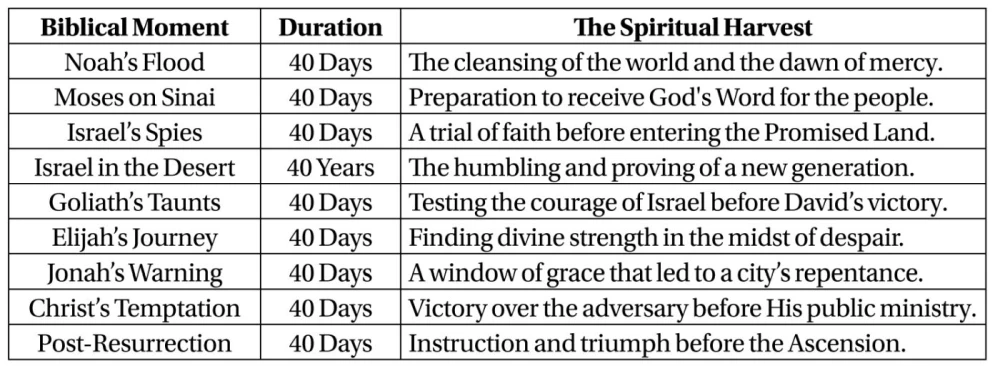
Throughout salvation history, God has used the “forty days” to prepare His people for a new beginning. We see this in the Great Deluge, where forty days of rain cleansed the earth for a new covenant with Noah. We see it in Moses, who spent forty days atop Mount Sinai, neither eating bread nor drinking water, to prepare his heart to receive the Law of God. And we see it in the prophet Elijah, who, strengthened by divine food, walked forty days to Horeb to hear the “still small voice” of the Almighty.
The table below reminds us that every “forty” in the Bible was a womb for something new:
Following the Master into the desert
Our Lenten journey is, above all, an imitation of Jesus Christ. By retreating into the Judean wilderness for forty days, Christ identified with our human struggles, yet He triumphed where we falter. His fast was not just a retreat but a “holy preparation” for the mission of salvation. Today, the Church invites us to unite ourselves with this mystery, moving away from a focus on simply “giving up” things and instead “opening up” our lives to God’s peace and compassion.
Calculating the days of renewal
In our Western traditions, Lent begins on Ash Wednesday and concludes on Holy Saturday, spanning 46 days. We exclude the six Sundays from the fast because every Sunday is a “little Easter”—a day to celebrate the Resurrection even in the midst of our Lenten journey. In Kohima, this journey begins with the solemnity of Ash Wednesday, a day when we are reminded that we are “dust,” not as a mark of shame, but to highlight our total dependence on the God who breathes life into us.
The shifting nature of the fast
Ancient Lenten fasts were rigorous “Black Fasts,” permitting only bread and water after sunset. Over centuries, the Church has moved from the “letter of the law” to a focus on “heart preparation”.
Today, we are invited to “disarm” our lives of luxuries and negative habits, making room for the Word of God to touch our hearts with docility.
The Nagaland “Revival Torch” and spiritual renewal
In Nagaland, our Lenten journey is beautifully intertwined with a call for local healing. The Nagaland Baptist Church Council (NBCC) has launched the “Revival Torch” Movement on January 22, 2026, at the NBCC Headquarters. This is a sacred moment of consecration intended to penetrate hearts and reshape character across all our churches.
A call to faithfulness and contentment
Rev. Dr. Mar Pongener has issued a clarion call for us to “drink from our own cistern,” reminding us that our persistent societal struggles in Nagaland—corruption, violence, and broken families—are often symptoms of a spiritual deficit. He urges us to make 2026 a turning point marked by “integrity over gain” and “faithfulness over compromise”. This local movement reminds us that Lent is a season to “Return to God,” reclaiming our sacred vocation to be a light in the darkness.
Pope Leo XIV: “Disarming” our language
The Holy Father’s message for 2026, “Listening and Fasting: Lent as a Time of Conversion,” invites us to a unique and practical form of abstinence: fasting from hurtful words. He urges us to:
i. Refrain from harsh words and rash judgment that wound our neighbours.
ii. Avoid the “serpent’s hiss” of slander and speaking ill of those who cannot defend themselves.
iii. Cultivate “digital charity” on social media, replacing hatred with hope and peace.
iv. Listen to the cry of the poor, recognizing that their suffering challenges our very way of life.
Archbishop Sarah Mullally: “Rooted in Love”
Across the Anglican Communion, the theme for Lent 2026 is “Rooted in Love,” led by Archbishop-designate Sarah Mullally—the first woman to be named Archbishop of Canterbury. Her message encourages us to explore what it means to belong to the body of Christ and how to live a Christ-centred life in an unstable world. We are called to be “Messengers of Hope,” carrying the light we have received into the places where despair and greed cast long shadows.
Invitations to grace
Lent is an invitation to rearrange our priorities. Here is a pastoral guide to navigating these forty days with intentionality:
The Do’s: Embracing the spirit
i. Do listen: Set aside ten minutes of quiet each morning to ask God, “What does my soul need?”.
ii. Do practice “Digital Fasting”: Use the time saved from scrolling to read the Daily Gospel or pray the Rosary.
iii. Do perform “Random Acts of Mercy”: Visit a lonely neighbour or a nursing home, sharing the hope you have received.
iv. Do support local missions: Your Lenten sacrifice can become a tangible blessing for vocational training or scholarships for those in need.
The Don’ts: Avoiding the pitfalls
I. Don’t be a “Gloomy Hypocrite”: Jesus taught us to hide our suffering and fast with grace, so that only the Father sees our hearts.
II. Don’t treat it as a “Detox Diet”: Lent is not a self-improvement program; it is a spiritual push to draw closer to the Savior.
III. Don’t indulge in “Luxurious Fasting”: Replacing meat with a lavish seafood buffet misses the penitential point of simplicity.
IV. Don’t give up if you stumble: If you forget your fast for a day, “buck up” and start again. Jesus fell three times, but He never stopped walking toward us.
A community united in the desert
Ultimately, Lent in Nagaland is about unity. Whether we are gathered at the Cathedral or marching at the Local Ground, we are one body in Christ. When one part of our community suffers due to tribalism or social unrest, we all feel the sting. This season is our shared journey toward liberation—a time to “Arise” from our divisions and “Shine” with the transformative power of the Gospel.
Let these forty days be more than a ritual. Let them be a period of gestation for a new life, where our words become instruments of peace, our fasts become fuel for justice, and our prayers lead us to the spiritual springtime of Easter renewal.