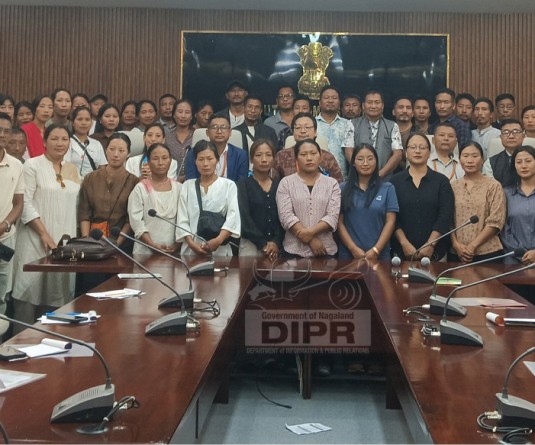
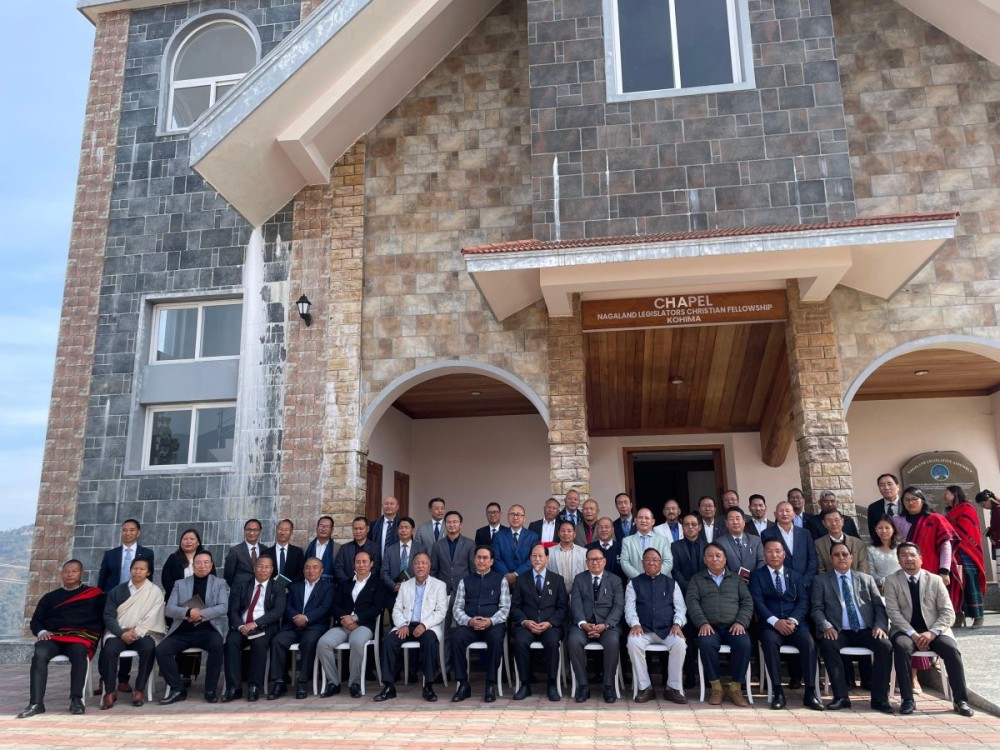
Nagaland Legislators led by Chief Minister Dr Neiphiu Rio, their spouses and NBCC staff and executive committee members after a joint fellowship programme in Kohima on February 1. (Photo Courtesy: NBCC)
Church–govt deliberations highlight differing views
Kohima, February 3 (MExN): Amid ongoing debate over the Nagaland Liquor Total Prohibition (NLTP) Act, 1989, the Nagaland Baptist Church Council (NBCC) underscored stricter enforcement of rules and regulations in Nagaland as the need of the hour, regardless of whether the Act is retained or reviewed.
“It is expected that, even if parties agree to lift the ban or not, stricter implementation and authorisation of legal, police and excise personnel to enforce rules and regulations in Nagaland is the need of the hour,” the NBCC noted.
The views were expressed during deliberations between NBCC executives, Chief Minister Dr Neiphiu Rio and legislators, following a joint fellowship programme in Kohima on February 1.
Church’s stance
According to a press release from the NBCC, it asserted during the meeting that the Church should not hold the government solely accountable for failures in implementation, nor should the government place the onus entirely on the Church.
However, it added that the deliberations concluded with an understanding on the need to continue dialogue and carry the engagement forward.
As per the Council, during the deliberations, the NBCC reiterated its stand in favour of stricter enforcement of the Act, citing legal loopholes that allow offenders to pay fines if apprehended.
It also highlighted structural gaps, including the non-constitution of the State Prohibitory Council and District Prohibitory Committees since the Act’s inception.
The council further expressed concern over workforce shortages, outdated infrastructure and limited resources in the Excise Department, stating that these limitations hamper efforts to tackle organised liquor syndicates.
It maintained that while alcoholism is a medical issue, it also carries moral implications involving choices that endanger lives.
Acknowledging limitations in its earlier approach, the NBCC noted that the Act had largely remained “clergy-centred” and emphasised the need to involve lay leadership in addressing the issue.
It also attributed prolonged inactivity in enforcement to a lack of political will, while observing that increased awareness has led many young people to abstain from alcohol.
‘Counter’ arguments
Legislators, on their part, raised concerns over the inflow of spurious liquor into the state and its impact on public health. They also highlighted the scale of black marketing, difficulties in curbing syndicates, and revenue losses associated with the Act.
Some legislators expressed the need to re-examine the Act, the NBCC noted.
Chief Minister Dr Neiphiu Rio also stated that the NLTP Act was a shared responsibility of both the government and the Church, calling for equal accountability, while a legislator noted that the latter cannot step away from its responsibility.
A suggestion was also made for the constitution of a smaller committee to continue discussions on the matter.
The disconnect
To this end, the NBCC noted that there is a seeming disconnect between the Church and the government on the NLTP Act.
While the Church expects full enforcement, viewing the government as the primary authority responsible for maintaining law and order, the government, in turn, expects the Church to collaborate in implementing the Act, it held.
However, the difficulties and complications in implementing the Act were not mentioned by the legislators, it added.
The NBCC stated that the discussions did not address in detail the practical challenges involved in enforcement, including constraints such as limited resources and personnel to counter organised syndicates, lack of cooperation from sections of the community, differing viewpoints, and setbacks arising from earlier regulatory and communitisation efforts.
“Although, in good faith we trust that the government is committed to doing good for the people, the complexities involved in implementing the NLTP Act remain shrouded,” it added.
Nevertheless, the NBCC asserted that for the Church, the need to implement the Act with greater thrust is “loud and clear.”
However, noting that the government appeared to be caught in what it described as a “whirlwind of public opinions,” the NBCC maintained that irrespective of whether the ban is lifted or retained, there is an urgent need for stricter implementation and clear authorisation to enforce rules and regulations.
The deliberations concluded with NBCC executives offering prayers for the Chief Minister and the ministry of the legislators, the release stated.
The fellowship, organised by the Nagaland Legislators’ Christian Fellowship at the State Chapel Hall in Kohima, was attended by NBCC staff and executive committee members, along with the Chief Minister and his spouse, legislators, and their spouses.