Morung Express News
Kohima | March 20
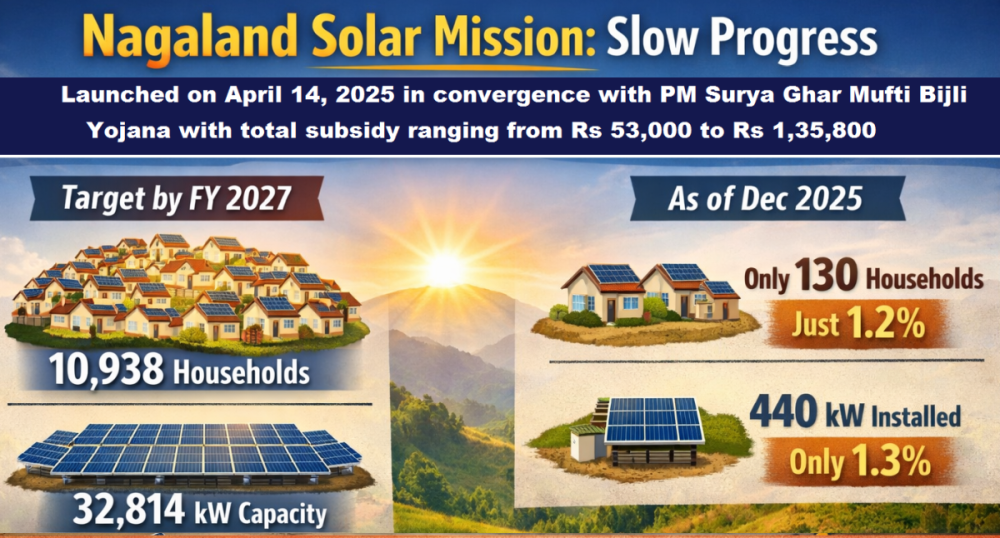
Nagaland’s rooftop solar push under the Nagaland Solar Mission (NSM) is yet to gain traction, with only 1.2% of targeted households covered so far, indicating a slow start to the State’s clean energy transition, official data showed.
Launched on April 14, 2025 in convergence with the Government of India’s PM Surya Ghar Muft Bijli Yojana (Roof-Top Solar Scheme - RTS), the mission aims to promote rooftop solar installations through additional State subsidies ranging from Rs 53,000 to Rs 1.35 lakh.
However, against a target of 10,938 households by Financial Year 2027, only 130 households or around 1.2% had been covered as of December 2025, according to the Annual Administrative Report (2025–26) of the Department of Power, Nagaland (DoPN).
In terms of capacity, just 440 kW has been installed against a target of 32,814 kW, translating to roughly 1.3% achievement. The department did not specify any reasons for the slow uptake.
As per DoPN, the scheme is aimed at reducing electricity bills, promote energy self-sufficiency, and lower carbon emissions. The department did not specify any reasons for the slow uptake.
Alongside rooftop solar, the State is pursuing larger grid-connected projects, including a 10 MW plant in Niuland, a 5 MW project in Zhadima (ongoing), and a 20 MW project in Chümoukedima (upcoming). A 40 MW solar project has also been proposed at Saijang in Peren district under a public-private partnership (PPP) model.
Meanwhile, Nagaland continues to face a wider power sector challenge. As reported earlier, with a peak demand of 193 MW, projected to reach 304 MW by 2035, the State depends on imports for 90–95% of its electricity, with installed capacity at just 29.4 MW.
This reliance has translated into rising financial pressure, with power purchase costs pegged at Rs 550.27 crore in 2024–25 against revenue of Rs 300.02 crore.
At the same time, high Aggregate Technical and Commercial (AT&C) losses remain a concern.
While the Department’s AAR (2025–26) is silent on AT&C losses, earlier data had placed Nagaland’s losses at 60.39% in 2020–21, the highest in the country. More recent assessments indicate some improvement, but losses still stood at 43.93% in 2024–25.
Reducing the AT&C losses is a key objective under the Revamped Distribution Sector Scheme (RDSS), which targets bringing them down to 12–15%, with smart metering as a central component.
While the Department reported progress in urban centres with over 15,600 meters installed out of 18,000 sanctioned in Dimapur, Chümoukedima and Kohima, it did not provide state-wide data.
However, as per data presented at a District Electricity Committee (DEC) meeting on RDSS held on March 3 in Kohima, only about 37,081 smart meters, or 11.4% of the target, had been installed as of early March across the State.
A DoPN official at the attributed the slow pace partly to public resistance and have called for greater awareness and cooperation to accelerate implementation.