Vishü Rita Krocha
Kohima | March 8
Despite multiple social obstacles and challenges, women in governance are driving inclusive growth by not just filling roles but also changing the narrative of power.
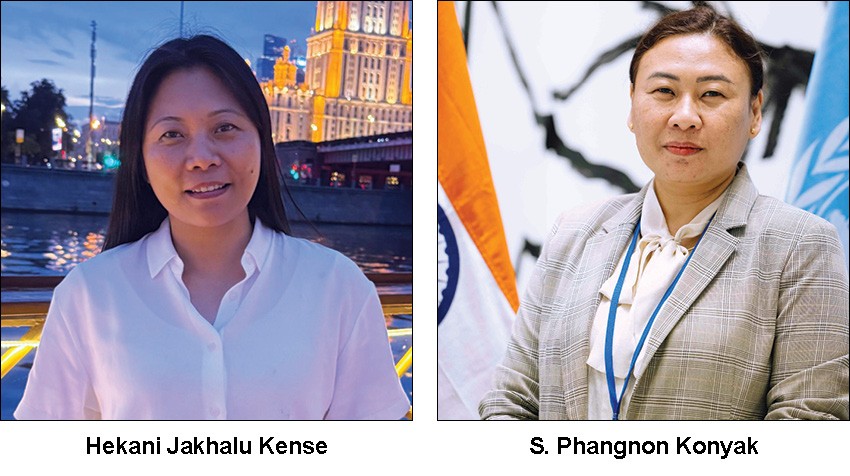
In March 2023, Nagaland state had scripted history by electing two of its first-ever women representatives to the Nagaland Legislative Assembly including Salhoutuonuo Kruse and Hekani Jakhalu Kense, who currently hold key portfolios of Women Resource Development and Industries & Commerce as Minister and Advisor respectively.
Marking another significant moment in history, S Phangnon Konyak also became the first woman to be elected as Member of Rajya Sabha from Nagaland in March 2022. She is also the second woman from the state to be elected to either House of the Parliament.
However, achieving these groundbreaking milestones were not without challenges and clearly indicate resilience and breaking the deeply rooted ‘patriarchal mindset.’
Carrying the voice of several women, Hekani Jakhalu Kense echoed that, “in the context of Nagaland politics, patriarchal mindset has been the main barrier.”
Speaking to The Morung Express, she remarked that, “Patriarchal mindset topped with misogynistic attitude always held women back.”
In her experience however, she stated that, “my husband, my brothers, my in-laws stood like solid rock.” But in many cases, she highlighted that, “it is very difficult and uncomfortable or in fact almost a taboo for a woman to tell the menfolk that she wants to join electoral politics.”
But the election of two women legislature now has broken the ‘taboo’ also reflecting in the Urban Local Bodies (ULB) elections wherein women councillors constitute 37% (above the 33% reservation).
In this regard, she also remarked that, “the ULB election showed some very interesting trends where it were the men who were fully in the field supporting their wives, daughters and daughters-in-law.”
In 2006, Hekani Jakhalu Kense relinquished her job as a lawyer to set up YouthNet, a youth organization in Nagaland to help and empower young people. 16 years later after giving her best to the organisation, she strongly felt that the work she was doing was not enough.
“There needed to be serious policy interventions and with my experience I felt I could contribute to the government in making programs and policies for our youth,” she related.
‘From can’t be, to can be in politics’
While she never planned to join politics and the family decision was made only eight months before election, she also felt that the focused issue on youth that she had been working on for many years gave her a basis and a platform to champion on a cause that she authentically believes in.
The other major push that motivated her to join politics was to fight for women “as women were never in political governance, there was always a silent acceptance that women are inferior to men.”
Even as she holds the position now, clearly the pressure and stress of a legislature can be overwhelming. But in her words, “when you have a supportive husband, more than half your problem is solved.” To this, she also expressed, “my husband, Alezo, with all his calmness, not only carries the responsibility along with me but also keeps a check on me that I remain balanced and rational.”
Wherever work takes her during the day, she said that, “I try my best to be home with my twins at night. I remind myself that even if I sacrifice my everything for the future of our people, if I can’t nurture my children right then I am a complete failure.”
Politics, she further pointed out, “is an equal playing field” while underscoring that, “we need to leverage on the qualities of a woman of being empathetic and with an emotional human touch to issues, but at the same time learn the games men play in politics too.”
With the glass ceiling being shattered now- “from women can’t be in politics to women can be in politics”, she advised the next generation of female leaders in politics to “start your financial planning, expand your network and connect with the grassroot.”
Under her leadership in the past three years, the Department of Industries & Commerce has made many interventions such as the Nagaland Trade & Investment Policy, Nagaland Start Up Policy, Nagaland Food Processing Industries Policy, 2024, and Nagaland Logistics Policy among others.
Policy, she underlined, will just remain in paper if it is not implemented, which is why, she also stated that, “we are going all out to empower our Micro, Small, Medium Enterprises (MSME) and entrepreneurs all across the state, to build a robust eco-system for businesses to thrive and thereby contribute to the local economy.”
Need to project as candidates
Impressing upon that women are still in the electioneering phase, and ‘not in leadership’, S. Phangnon Konyak, the first woman from Nagaland to be elected as Member of Rajya Sabha underscored that, “one thing is that women need to come out and participate in politics.” “We can’t blame other people, but we need to put ourselves out there,” she affirmed.
From the government side, she highlighted that there is the 33% reservation for women in the ULB elections, but strongly maintained that, “we need to project ourselves as candidates.”
Even as women are not easily accepted as male candidates when it comes to politics, she emphasized that, “we need to put on our own efforts and be ready to face the challenges.” While the challenges may vary, in her case, one of the challenges besides the strong patriarchal mindset was all her efforts and hard work being discredited following her election.
S Phangnon Konyak had joined the BJP in the year 2017 and subsequently served as the General Secretary of the BJP Mahila Morcha, Nagaland. In 2020, she was further appointed as the State President of BJP Mahila Morcha.
“We had a good team, and we really worked hard. All our efforts throughout made an impact and were recognised by the party leaders,” she highlighted.
However, when she became an MP in 2022, she expressed that, “it was like all my efforts of working in the Party was discredited.” Highlighting that the Oting incident happened coincidentally despite discussions in this regard being held prior to her election, she also voiced that, “I became a soft target for everyone. Social media trolls went on and on. Public leaders endorsed it unofficially.”
Stating that they don’t just give away MP seats like that, she however chose to stay silent. “By God’s grace, I focused on my work,” she expressed.
Challenges like these will come, she further highlighted while impressing upon that people would dissect women minutely and try to pinpoint. However, once you are in the position, she said, “it depends on your performance” and further acknowledged the strong support system of her community.
‘Women need to support women’
With regard to more representation of women in policy making, she underscored that, “women need to support women.” “We cannot always expect men to support us. We need to step out and get out of polarizing narrow thoughts.”
Observing that sometimes women are more patriarchal than men, she asserted that, “for society to progress, we need both men and women. Everyone needs to come together.” She also maintained that “we are so polarized now” while explaining that, “this has a very negative effect that goes down to khels and clans.” And in the event of being so minutely polarized, she also posed, “How can we think of progress?”
In the meantime, she underlined that democracy is something that needs to be understood in its true sense while explaining that it is also freedom within limits where we don’t disturb the freedom of others.