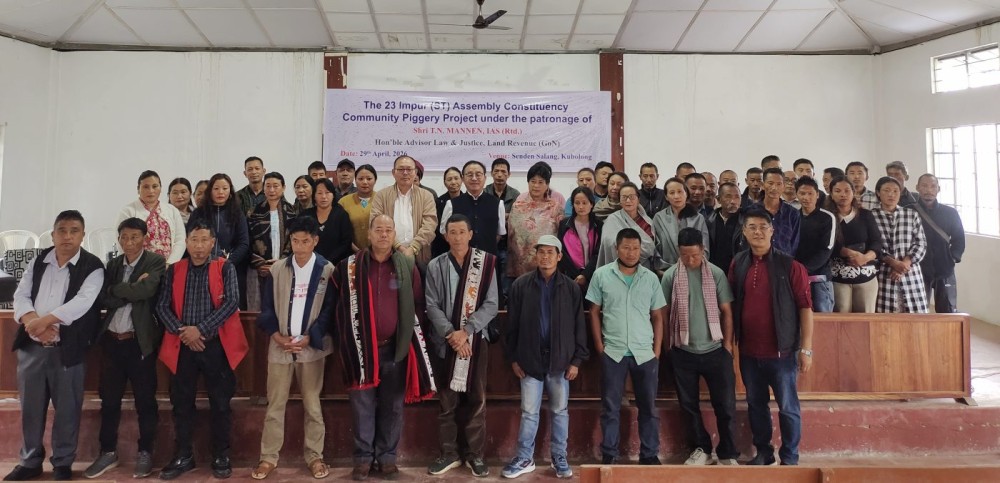
Beneficiaries along with dignitaries pose for a group photograph during the launch of the 23 Impur (ST) Assembly Constituency Community Piggery Project at Senden Salang, Kubolong in Mokokchung district on April 29. (Morung Photo)
169 piglets distributed to 105 beneficiaries
Morung Express News
Kubolong | April 29
The inaugural programme of the 23 Impur (ST) Assembly Constituency Community Piggery Project was held at Senden Salang, Kubolong on April 29, marking the rollout of a pilot livelihood initiative under the LADF for the Asetkong range.
The project, organised by the Think Tank Committee, Asetkong under the patronage of T N Mannen, Advisor for Law & Justice and Land Revenue, Government of Nagaland, aims to promote sustainable livelihood through community-based piggery development.
Addressing the gathering, Mannen stated that the initiative was conceived as a “community participatory project” to strengthen the rural economy by leveraging piggery as a viable income-generating activity. He said detailed guidelines have been formulated to ensure proper implementation and long-term sustainability, noting that many projects fail due to lack of structured execution.
The guidelines, developed with inputs from the Think Tank team and the Department of Animal Husbandry & Veterinary Services (AH&VS), describe the initiative as a pilot initiative covering the Asetkong range under 23 Impur Constituency. It highlighted that nearly 70 percent of Nagaland’s population depends on agro-forestry practices, including jhum cultivation, and emphasised diversification into allied sectors such as piggery, poultry, and fisheries for sustainable economic opportunities.
A total of 105 beneficiaries received 169 piglets—151 female and 18 male—sourced from outside the state, including West Bengal, after veterinary clearance. The distribution covered all villages and blocks under the constituency in the Asetkong range.
Mannen observed that traditional pig rearing practices are often constrained by poor housing, inadequate nutrition, irregular healthcare, and substandard breeding management, affecting productivity. He said the project seeks to address these gaps through scientific intervention and collective participation.
The guidelines outline a structured approach including backyard pig breeders and fattener units, maintenance of a 1:10 boar-to-sow ratio to prevent inbreeding, and mandatory lineage record-keeping. Beneficiaries are required to construct pigsties as per technical specifications prior to receiving piglets, with roofing support provided under the scheme.
A Project Medical Team (PMT), led by a qualified veterinarian, has been constituted to oversee animal healthcare, conduct inspections, and provide technical guidance. A Governing Body-cum-Monitoring Committee comprising representatives from the Think Tank team, village councils, beneficiaries, and veterinary officials will supervise implementation.
The project also introduces a “Pig Bank” mechanism, under which each breeder unit will contribute one piglet from the second farrowing for redistribution to new beneficiaries in subsequent phases.
Feed mill units using locally available raw materials are also proposed to reduce production costs.
Village councils have been tasked with selecting eligible beneficiaries and forming village-level management committees, while beneficiaries are required to adhere strictly to feeding, healthcare, and breeding guidelines. The document also mandates that breeding pigs should not be sold before two to three years without prior approval.
Mannen maintained that the success of the project would depend on “full hearted cooperation and sincere implementation” by beneficiaries, along with active involvement of village councils. He added that the initiative has the potential to transform Asetkong into a pig surplus area if successfully implemented.
Highlighting support measures, Mannen announced that he would personally bear the 15 percent insurance premium required from beneficiaries under the National Livestock Mission (NLM), with the remaining 85 percent covered by the Central and State governments.
Following the inaugural session, an orientation for beneficiaries was conducted by Dr Simon Ao (Retd.), former Deputy Director and Joint Director, AH&VS Nagaland, and Dr Sarendi Walling, ACTO, Animal Science, KVK Mokokchung.