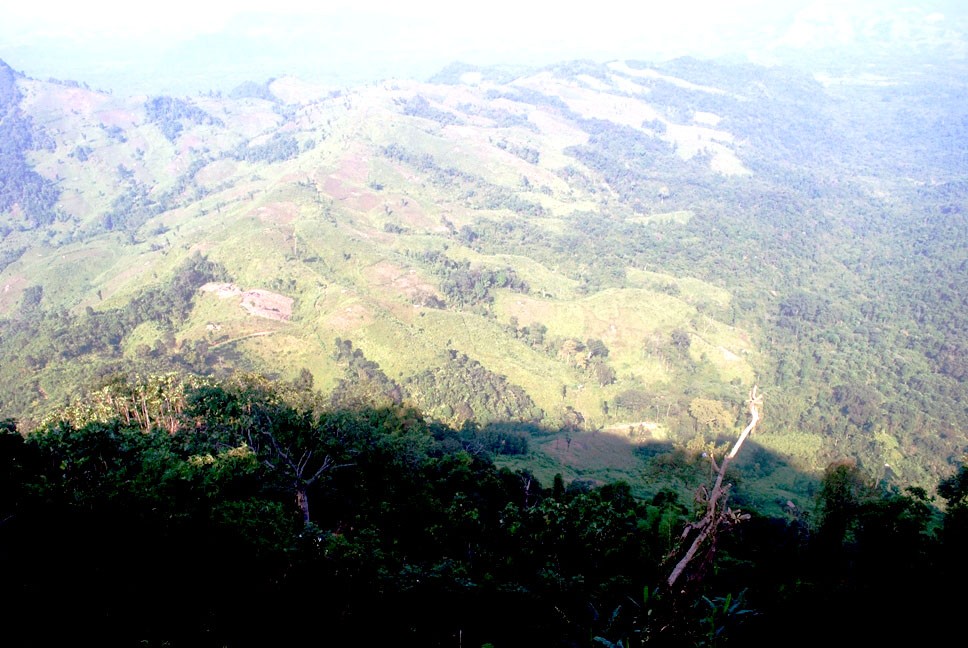
A view of the Tizit valley which was suggested during the DPDB meeting to shift Wangla village in the plain areas of Tizit for easy construction of roads. (Photo/Emilo Khuvung)
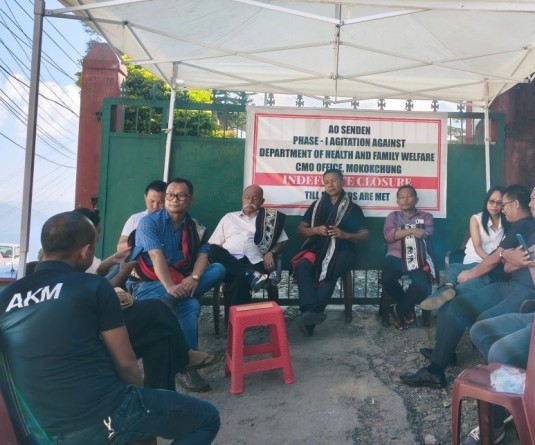
Mon, November 17 (DIPR): The Mon District Planning & Development Board (DP&DB) meeting was held at Wangla village on November 15 under the chairperson of Deputy Commissioner, Mon, Angau I. Thou.
The main purpose of hosting the meeting in this remote village is to see the ground reality of the people living in the rural area and to propagate about the policies, programmes and other activities of the Government and also to assist the rural mass.
Wangla is a small village with a population of 1,800 people, mostly cultivators. It is 17 Kms away from the district Headquarters Mon with one hour ride. The village is situated on a hillock below Amanhong hills, surrounded by beautiful, nature-gifted, lush green scenery. The panorama view of Tizit valley from the Angh’s Morung of Wangla village is a thing of beauty for the villagers and admiration for the outsiders. She shares her border with Hongphoi, Ngangting, Oting, Longlam, Pongkong, Lapa and Longkai villages. Although it’s a small village with 149 households, Wangla is one of the oldest villages in the district. It is said that many villages have bifurcated form Wangla in the past. The Wangla village originated from a place called ‘Alemkaphen’ which means ‘Gate of the sun’.
Prior to 2009, this village was totally cut off from the rest of the district, because of the fact that there was no proper road connectivity. There were no bus or taxi services, and the people had to walk on foot till Hongphoi village to come to Mon town. At present, the road is properly connected with black toping under PMGSY and daily taxi service (Tata Sumo) is plying from Mon to Wangla. The village was also not connected with water supply till few days ago. But it was temporarily connected by the PHED just before the conduct of the DPDB meeting as assured by the department.
Wangla is gifted with a charming landscape with a luxuriant, green Amanhong forest above the village. This rich green forest provides a natural habitat to different species of flora and fauna. Different kinds of birds migrate to this forest round the season. In order to protect this rich natural beauty of Amanhong forest, the village council has declared the Amanhong forest as a Birds Sanctuary in the DPDB Meeting. Besides this, the village council has also taken a strong resolution to donate free land for taking up Government projects/schemes at Wangla. They also submitted a proposal to the DPDB for construction of road from Wangla to Tizit.
Wangla is also blessed with a rich fertile soil suitable for all crops. Majority of the populace are cultivators and are engaged in traditional method of farming. With the intervention of World Vision India and Agri. & Allied departments, her economy has developed up to a certain extent. If the potentiality of her soil is utilized with the latest scientific method of cultivation, then Wangla can become an economically viable village.
In this connection, the DC Mon Angau I. Thou urged upon the Government officers, to sensitize the villagers to know their rights. She also asserted that her desire to hold DPDB at Wangla is to assist the villagers, because it has become an orphan village in developmental aspects. She emphasized on quality education, unity of the people and to have good relations with the Government officers. Stressing that unity and mutual relations are the strength of the people, she said everything becomes possible when there is unity and good relationship.
One of the key reasons why Wangla is still lagging behind in development sector is that, this village falls under Tizit constituency, while Block wise, it falls under Mon RD Block. For this reason, Aloh Wangham MLA & Chairman DAN pointed out that there are certain obstructions to carry out certain developmental projects in Wangla. He suggested the villagers in the DPDB Meeting to shift Wangla village in the plain areas of Tizit valley for easy construction of roads. Aloh also cited an example that his native village Jaboka has remained isolated and neglected for years when it was situated on the hilltop. With the shifting of Jaboka village in the foothills, it is now connected with roads to Assam, Arunachal Pradesh and Tizit, he added.
The literacy rate of this village is 34%. The village has one Government primary School with 94 students and four teachers. Wangla also has one private school with attached hostel sponsored by the village council. The enrolment of the students in the private school is 140. The Education department has provided free textbooks and uniforms to these schools, while the Medical department has provided 15 cots to the hostel. The district administration has provided red blankets for the GBs, blankets for the aged persons and CFLs for the villagers. The NRHM team conducted health camp where 155 patients were examined and provided free medicines. The PHED has assured to construct Public toilets and bathrooms at the Angh’s residence and the schools. The department of Food & Civil Supplies provided 50 quintals of rice. Sports goods were provided by the 6th Assam Rifles, Mon. Besides this, various other departments also contributed different essential items to the villagers.