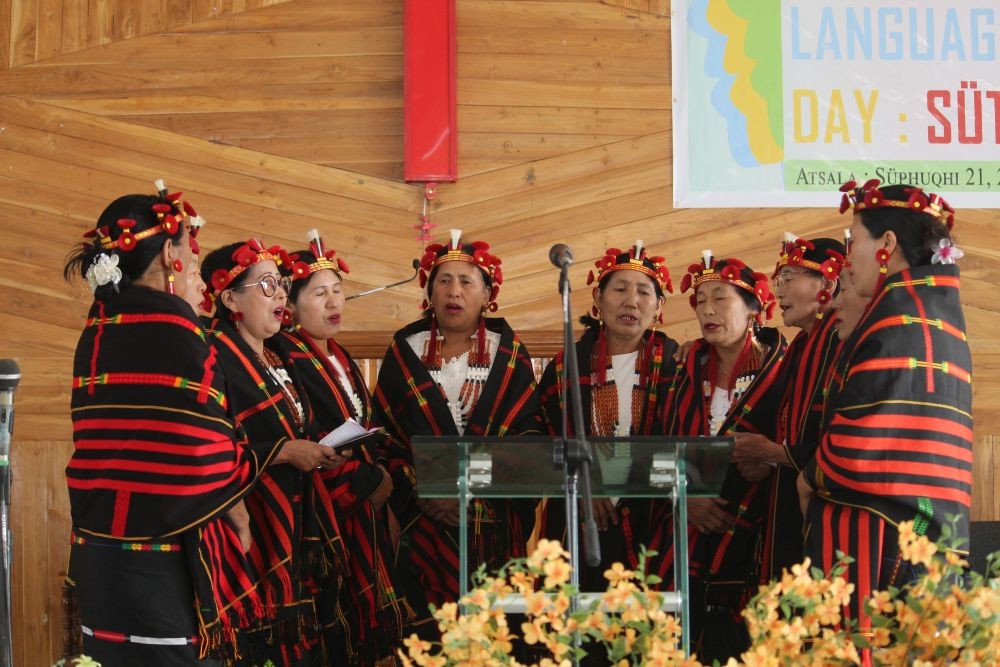
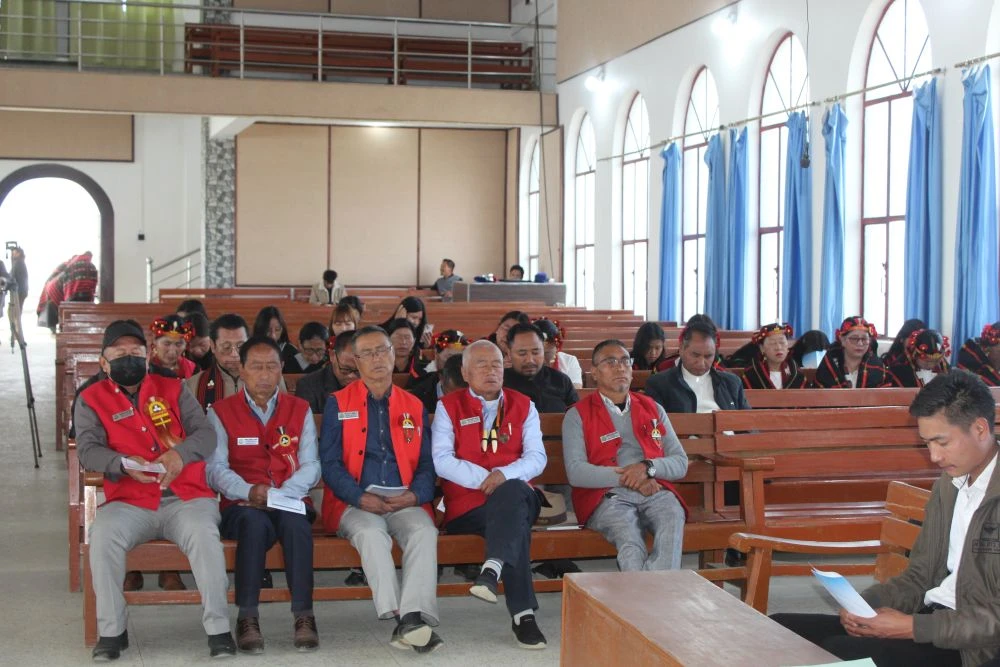
A group presenting song during the International Mother Language Day observed at Aghunato Town Baptist Church, Nito Mount, on February 21. (Morung Photo)
Sumi Literature Board observes International Mother Language Day
Morung Express News
Zunheboto | February 21
The Sumi Literature Board (SLB) observed International Mother Language Day at Aghunato Town Baptist Church, Nito Mount, on February 21, under the theme ‘youth voices on multilingual education.’
SLB Chairman Vihoshe Muru, in his address, highlighted that that SLB’s first programme was held in Dimapur in 2025 and the Aghunato event marked their second observance. The next celebration would be held in Atoizu, he informed.
Emphasising the importance of mother tongue, he said, “While the Sumi community and Nagas in general focus heavily on English-medium education, such occasions serve as reminders to preserve and prioritise their own language.”
He stressed that acquiring knowledge and education should be prioritised over material pursuits and underscored the vital role of mothers in teaching and guiding their families. He encouraged parents to allow and lead their children to read the Sumi Bible if they want them to learn and speak the mother tongue fluently.
Speaking on the new edition of the Sumi Bible, Muru urged the community not to remain passive critics but to come forward with constructive suggestions and solutions for corrections and clarifications.
He also highlighted SLB’s achievements, stating that Sütsà - the mother tongue of the Sumi Naga community was introduced as a subject at the HSLC level in 1980 and implemented at the HSSLC level in 1997. “Efforts have been ongoing for more than 27 years to introduce the subject at the college level, but the number of Sumi authors remains limited,” he added.
He acknowledged Rev Dr Najekhu, who has published more than 80 books in Sütsà and was honoured by SLB as the “Man of Literature.” He expressed concern that many Sumi people show little interest in purchasing and reading Sumi books.
State-level committee has already approved the introduction of Sütsà at the college level, Muru said and added “the subject would also be included in central competitive examinations.” A Sumi chronology, along with Sumi judicial and customary laws, will soon be made available, and the notification will be shared through the Sumi Küküpütsa newspaper.
Hetoho S Zhimomi, President of Sumi Kukami Hoho, expressed happiness over the implementation of Sütsà at the BA level. He urged SLB to preserve traditional words and meanings passed down from their forefathers while also coining new terms where necessary.
He encouraged community leaders to speak Sütsà boldly and called upon church leaders, especially after completing theological studies, to undertake at least a three-month Sütsà crash course.
G Ikuto Zhimomi, MLA and Advisor for Land Resources, who attended as the special guest, noted that Aghunato is the senior-most subdivision and will celebrate 75 years next year. He recalled the first Indo-Naga battle fought at Hoshepu Village under Aghunato Sub-division Zunheboto district. “If the language is not protected, it could face extinction. Sumi has to be united,” he asserted.
The theme speaker, Kuholi Chishi, retired Director of Higher Education said multilingual education should encompass international, regional, and mother languages. “While the mother tongue currently faces limitations, including a shortage of teachers and job opportunities, progress is being made,” she emphasised that multilingualism fosters cultural understanding and social connections.
She urged parents to take responsibility for guiding their children, observing that many are reluctant to teach the mother tongue and instead prioritise English. “Education begins at home and that multilingual education is most effective when rooted in family learning.” She encouraged the youth to practice the language actively rather than merely speaking about its importance, and to strive to become both responsible local citizens and competent global citizens.
The event also included the felicitation of Sütsà students. The Rev Dr Najekhu Yepthomi Award for HSLC Sütsà Topper 2025 was presented to Viloto Aye. The Lukhashe and Nikhuli Awards for HSLC and HSSLC Sütsà Toppers were awarded to Viloto Aye and Mughaliho Nekha respectively. The Sütsà Academy Topper 2025 award was conferred on Nupato Zhimo, Assistant Youth Leader, ZTSBC.
The programme was chaired by Bohoto Z Zhimomi, Joint Secretary SLB, invocation by Kito Shohe, Pastor ATBC, welcome address by Shekiye Yeptho, Deacon Chairman, a poem recitation by Dr Hotokhu Chishi, Vice Chairman of SLB, women’s folk song by Aghunato Village Baptist Church, and the release of 11 Sütsa books by the special guest. Other highlights included a poem by Kivimi Jimo, a Sütsà student; exhortation by Akukau Kashito Yepthomi of Ghuvishe village; and benediction by Rev Victo Shohe, Secretary Children’s Ministry, SBAK Nito Mount.
Sütsà approved for NU under FYUGP: SLB Secy
Expressing concern over the declining use of indigenous languages, Jekugha Assumi, Secretary of SLB, underscored the critical role of mother tongues in shaping individual identity and cognitive development.
Speaking after the meeting, Assumi described the mother tongue as the first language acquired at birth and a fundamental pillar of a person's cultural identity.
He pointed to a visible decline in the usage of native tongues, attributing the trend to the overwhelming dominance of English in educational institutions and daily communication.
Providing an update on efforts to promote the Sumi language, Assumi informed that Sütsà has been approved for introduction under the Four-Year Undergraduate Programme (FYUGP) at Nagaland University. While the state government has already granted its approval, he noted that certain procedural formalities remain before implementation. He expressed optimism that the course would be introduced within the current year.
Addressing misconceptions regarding the utility of mother tongues, Assumi referred to the National Education Policy, which emphasises instruction in the mother tongue until at least Class 5. Citing research, he explained that cognitive development occurs most effectively in one's first language, which subsequently forms a strong foundation for acquiring additional languages. “Proficiency in the mother tongue strengthens the ability to learn other languages, including English,” he stated.
On the subject of employment, Assumi noted a positive development in recent central examinations, which have allocated marks for proficiency in mother tongue subjects. This, he said, “could benefit candidates.” He emphasised that the value of preserving mother tongue extends far beyond job prospects. “The preservation and mastery of one's mother tongue contribute significantly to personal growth and identity,” Assumi concluded.