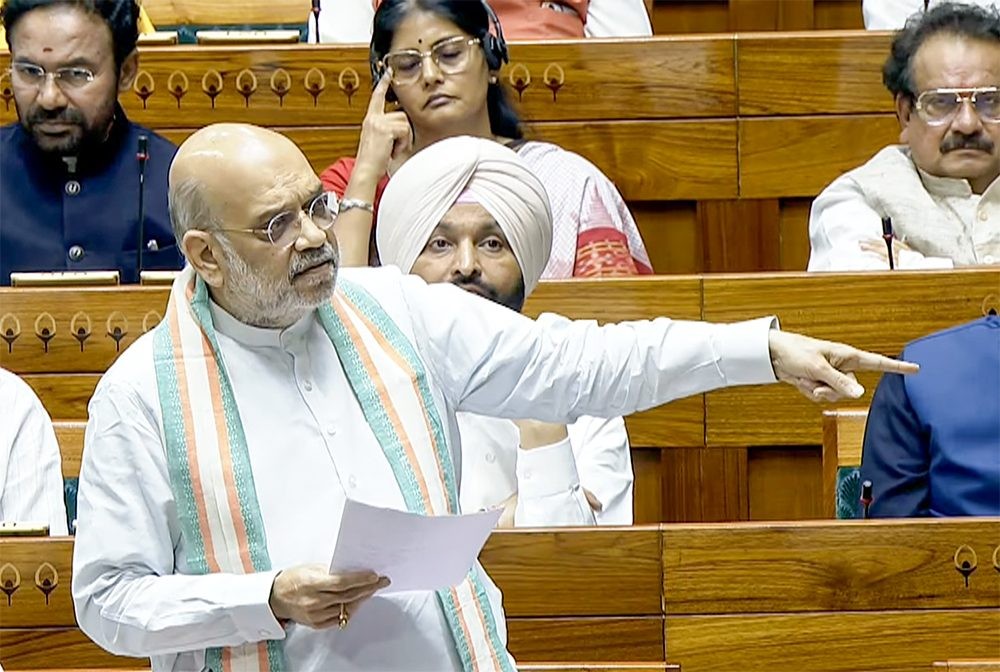
New Delhi: Union Home Minister Amit Shah speaks in the Lok Sabha during the second part of the Budget Session of Parliament in New Delhi on Monday, March 30, 2026. (Photo: IANS/Sansad TV)
New Delhi, March 30 (IANS) Union Home Minister Amit Shah on Monday declared in the Lok Sabha that India has virtually become Naxal-free, with the dreaded Maoist central and state leadership structures almost completely eliminated just a day before the government’s self-imposed deadline of March 31, 2026.
Addressing a debate on Naxalism, HM Shah provided a detailed account of the massive success achieved under the Modi government’s zero-tolerance policy.
He stated that the Maoists’ central committee leadership has been neutralised or forced to surrender. Out of the top leadership, 12 have been killed, and only one is absconding, with talks underway for his surrender as well. In the state committees, the picture is equally decisive.
The main 27-member state committee in one key affected state was wiped out — 11 killed, with talks initiated with two others.
In Madhya Pradesh and Maharashtra-Chhattisgarh, three members of the state committee surrendered, leaving only three.
In Odisha, one surrendered, and three were killed.
In Telangana, three were eliminated, leaving no member of the State Military Commission (SMC) intact anywhere.
HM Shah revealed impressive overall figures; In the last three years, 4,839 Maoists have surrendered, 2,218 have been arrested, and 706 have been neutralised in encounters.
He emphasised that the government has consistently offered dialogue and rehabilitation to those willing to lay down arms, but those who continue to fire on security forces, tribals, farmers and children will be dealt with firmly through bullets when necessary.
The Minister credited the success to a well-coordinated strategy combining security operations, development initiatives and advanced technology.
He highlighted major operations such as Operation Octopus in the Gumla, Lohardaga, and Latehar districts of Jharkhand (earlier in the Bihar context in the speech), Operation Thunderstorm in Jharkhand, and Operation Chakra in Bihar districts.
A particularly intense 21-day operation on a strategic hill on the Telangana-Chhattisgarh border dismantled a permanent Maoist camp stocked with five years of food grains and facilities for 400-500 cadres.
Despite extreme heat and difficult terrain, security forces showed exemplary courage. HM Shah paid rich tributes to the valour of CRPF, Cobra, District Reserve Guard and state police personnel, especially in Bastar, saying the region, once synonymous with red terror, is now witnessing rapid development — schools, ration shops, Aadhaar cards, food grain distribution and basic amenities reaching every village.
He criticised previous governments for neglecting tribal areas for decades, allowing Maoists to exploit the vacuum and mislead innocent tribals with false narratives of fighting for justice.
“The truth is that development was denied to Bastar because of red terror,” HM Shah said, adding that after 2014, every poor citizen, including those in Naxal-affected regions, has received houses, gas connections, drinking water, insurance cover and food security.
With the Maoist organisational structure in most states dismantled and only a negligible presence left, HM Shah expressed confidence that the dream of a Naxal-free India has been virtually realised.
He assured the House that once the final formalities are completed, the country will be officially declared free from the decades-old menace of left-wing extremism.