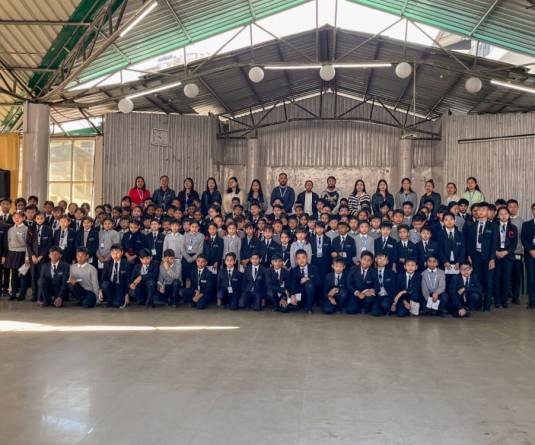
Mokokchung, November 6 (MExN): The Internal Quality Assurance Cell (IQAC) of Jubilee Memorial College (JMC) organised a one-day seminar on “Framing of Research Project and Research Grants & AI, Open Access and Research Integrity” on November 4.
The seminar began with a welcome address by JMC Principal Dr Imtiwati Jamir, who highlighted the importance of research as an integral part of academia and underscored the relevance of the themes taken up during the seminar.
The seminar was conducted in two sessions, with the first focusing on “Framing of Research Project and Research Grants”.
Dr Suraj Beri, Assistant Professor, Department of Sociology, Nagaland University, delivered a lecture on “Framing the Research Proposal”. He explained the differences between preparing research proposals for PhD programmes and research projects, emphasising that the latter are essentially linked to funding agencies.
He also introduced various funding bodies and outlined the steps prospective applicants should follow while preparing research proposals, including the information and requirements considered by funding agencies.
Dr Narendra Lamba, Assistant Professor, Department of Sociology, Nagaland University, spoke on “How to Apply for Research Grants”. He outlined various funding agencies and the areas covered by research grants, besides discussing application procedures, proposal preparation and budget planning.
He also explained the common reasons for rejection of grant applications and the requirements applicants should fulfil to improve their chances of securing funding. Drawing from his own experience in applying for and obtaining research grants, Dr Lamba illustrated the discussion with several examples.
The first session was moderated by Tsungrosenla Jamir, Assistant Professor, Department of English, JMC, while Shisachila Imchen, Assistant Professor, Department of History, JMC, served as rapporteur.
The second session, themed “AI, Open Access and Research Integrity”, examined the role of artificial intelligence in academic research, with discussions focusing on Open Access initiatives such as One Nation One Subscription (ONOS), bibliographic databases such as OpenAlex, and the ethical use of AI in literature searches.
The discussions highlighted the importance of widening access to scholarly resources, ensuring copyright compliance and data privacy, and maintaining accuracy in research. The session also examined challenges relating to plagiarism and AI detection, with emphasis on the limitations of automated detection tools and the importance of faculty judgement.
The resource persons for the second session were Dr T. Temjen, Deputy Librarian, Central Library, Nagaland University, Lumami; Dr Chanlang Ki Bareh, Assistant Librarian, Central Library, Nagaland University, Lumami; and Er Ochentsungba Ozukum, Information Scientist, Nagaland University, Lumami.
The session was moderated by Molongnenla, Assistant Professor, Department of History, while Phalneihoi Thepfusono Hangsing, Assistant Professor, Department of Psychology, served as rapporteur.
The session concluded with the moderator expressing gratitude to the resource persons for their presentations and the participants for their active engagement.