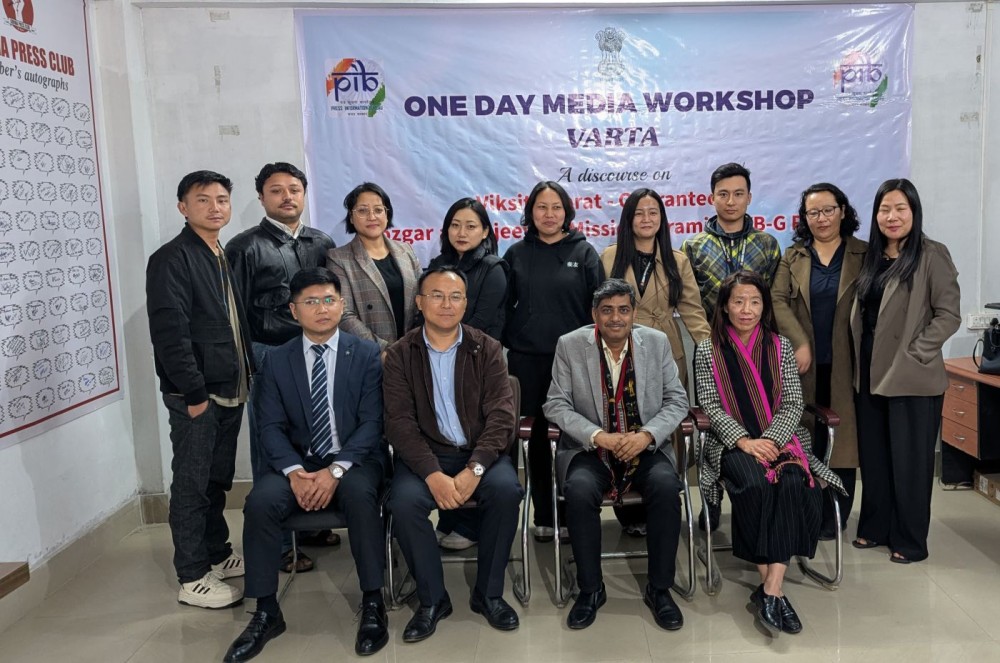
Prof Jayanta Choudhury, Head of the Department, Department of Rural Development and Planning, Nagaland University (2nd from Right) seen with PIB Officials and members of Kohima Press Club on March 25.
Morung Express News
Kohima | March 25
Prof Jayanta Choudhury, Head of the Department, Department of Rural Development and Planning, Nagaland University today underscored that rural development is at the centre of development while citing that almost every goal of Sustainable Development Goals also depends on how rural development can be made better through holistic and participatory approach.
He was speaking as resource person for a discourse (Varta) on the recently rolled out central scheme, “Viksit Bharat–Guarantee for Rozgar and Ajeevika Mission (Gramin)” or VB–G RAM G under Ministry of Rural Development organised by the Press Information Bureau (PIB), Kohima on March 25 at Kohima Press Club Office.
The discourse, which was moderated by Andrew Lalchhandama (IS), Media & Communication Officer, Press Information Bureau, Kohima extensively deliberated on VB–G RAM G, that was previously known as MGNREGA (Mahatma Gandhi National Rural Employment Guarantee Act).
Stating that the VB-G RAM G is designed to guarantee 135 days of wage employment per rural household, Prof Jayanta Choudhury said that the scheme proposes a 60:40 centre-state funding share with North Eastern and Himalayan States receiving a higher 90% central funding share, also addressing rural employment gaps and support livelihood initiatives.
Some of the key changes from MGNREGA, he highlighted are shift from demand-driven to supply-driven model, wage and employment days, fiscal responsibility, technology and monitoring, and parliamentary committee concerns while pointing out that many recommendations remain unimplemented, raising concerns that VB-G RAM G could weaken safety nets instead of strengthening them.
Further elaborating on the key changes, he also stated concern that rural work is restricted during peak agricultural seasons to prioritise farming activities, which he said, could affect rural wage earners relying on continuous employment. He said that past MGNREGA wage adjustments which lagged behind agricultural wages remain an unresolved concern.
On the implications for rural households, he emphasised that while the scheme promises more employment days, actual benefits may be limited due to allocation restrictions, supply-driven planning and peak-season work bans. Stating that dependence on technology for attendance may create barriers to wage receipt for low-connectivity areas, he said that, “the fiscal shift to states could exacerbate disparities among poorer and high-migrant-sending states, affecting program effectiveness.”
He also underlined that, “its success will depend on careful implementation, monitoring, and state-level capacity to manage allocations while consuring fair wages and technological accessibility.”