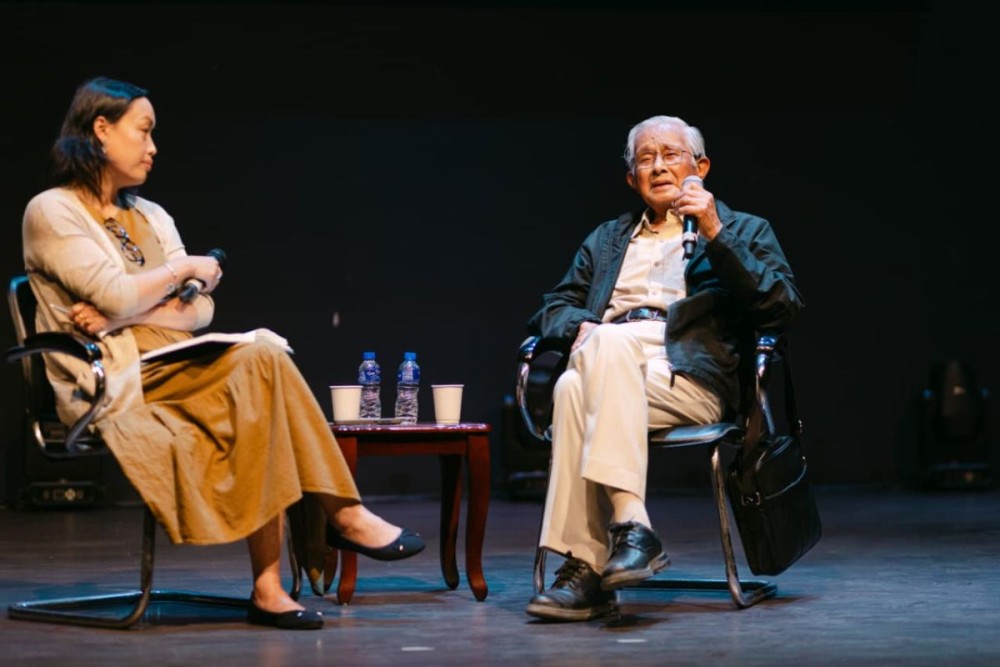
Niketu Iralu speaking at an interactive dialogue held at Lorin Hall, Tetso College, organised by TakeOne Production on February 24. (Photo Courtesy: TakeOne Production)
Naga peace advocate Niketu Iralu urges collective responsibility
Morung Express News
Chümoukedima | February 24
Veteran Naga leader and peace advocate. Niketu Iralu on Tuesday called on young people to take personal responsibility for building a peaceful and just society, warning that failure to do so could push communities “into a black hole of our own creation.”
Speaking at an interactive dialogue held at Lorin Hall, Tetso College, organised by TakeOne production house, following a screening of a documentary on his life, Iralu said the future does not rest with elected representatives alone but with ordinary citizens willing to live ethically and courageously.
Rejecting the tendency to shift blame to legislators, he said, “We cannot say the 60 MLAs will solve our problems. If we leave everything to others and live irresponsibly, society becomes impossible. That is bankruptcy of thought and mind.”
“Without each of us claiming responsibility, the burdens we are creating become too dangerous. We are sliding down the black hole of our own making,” he cautioned.
Transformation must begin within
The interaction turned reflective when a participant referred to From Headhunters to Church Blunders by Paul Hathaway and asked how oppressed societies can avoid becoming oppressors themselves.
Acknowledging the painful history of the Nagas, Iralu said transformation must begin within.
“Pray about your worries, anger, hopes and dreams,” he said. “But then go further and ask — is there anything you expect me to do? And then dare to obey it.”
Quoting Richard Rohr, he said, “Hurts not transformed are always transferred,” and warned that unless individuals confront their own cruelty and selfishness, they risk becoming “worse oppressors” than those who hurt them.
Trust —the foundation of meaningful dialogue
Another participant questioned why Naga elders often frame discussions primarily through Biblical references and whether indigenous Naga values of kindness and community care risk being overshadowed by Christianity.
Drawing from decades of engagement across India, Iralu said he has worked with Hindus, Muslims, Buddhists, Jains and Parsis in cities such as Mumbai and Kolkata and found that trust — not theological superiority — is the foundation of meaningful dialogue.
“When I am really honest about where I was wrong, where I was selfish, where my agenda was pushed at the expense of truth, they immediately understand. They can trust me,” he said.
“When a Hindu or Muslim speaks honestly about where things have gone wrong and how he or she has put it right, I say — this is what I need.”
Asked what viewers unfamiliar with him should take away from the documentary, Iralu said it portrays not a legacy but a continuing journey shaped by what he described as “the still small voice.”
“It was a journey — and it is a journey continuing. This is not about me alone. There is still a small voice in everyone,” he said, clarifying that he does not claim moral superiority.
On the conflict between logic and conscience, which often seeks approval, and conscience, which prioritises integrity, he said both are part of human equipment but must work together, adding that mind, heart, conscience and soul must function in harmony.
When asked what worries him most about Naga society, Iralu pointed to complacency.
“We have allowed a smug complacency. Beyond Dimapur, the rest of the world starts. That holiday is over,” he said, warning of “bigger, tougher, more overwhelming issues” descending on society.
In a digital age dominated by smartphones and constant noise, he described it as “the hugest challenge” for young people to hear the inner voice.
“We must make these tools our servant, not our master,” he said.
‘Though small we are, we have our story’
On education, he stressed historical consciousness, recalling the Naga struggle from colonial resistance to post-Independence conflict. Quoting George Orwell, author of Animal Farm and 1984, he said “the most effective way to destroy people is to obliterate their understanding of their own history.”
“No people should underestimate their story. Though small we are, we have our story,” he said, adding that concern over limited resources, climate change, economic disparities and artificial intelligence should drive educational reform rooted in responsibility.
When asked about the one lesson he wished young people understood, Iralu replied, “Put things right.”
“If there are things that need to be put right, just put them right,” he said, invoking Mahatma Gandhi’s line, “Be the change you want to see in the world.”
Distinguishing moral courage from reckless bravado, he said the real strength lies in following truth even without institutional backing.
“That kind of courage — following something beyond yourself that you know deep down is right — that is most important,” Iralu said.