(Source: AI)
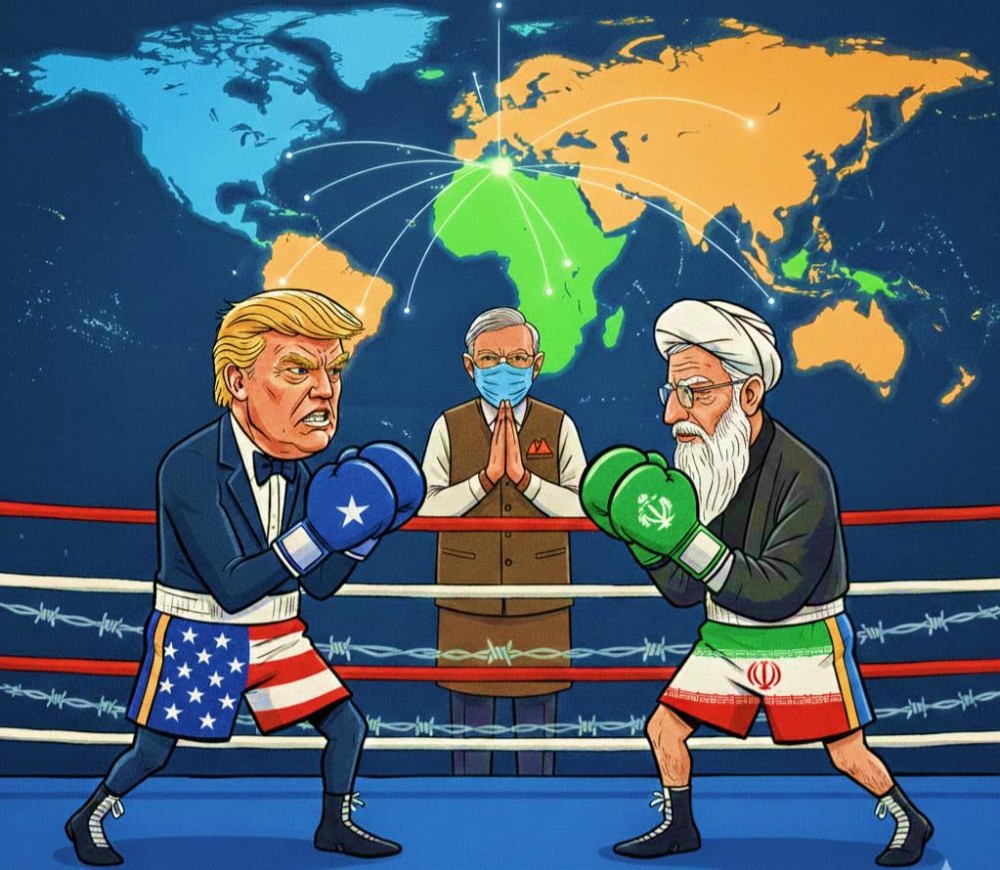
-USS Abraham Lincoln strings a massive fleet into striking range, yet New Delhi stays soundless as eloquence accelerates.
-Hegseth’s stark warning: “All options” on the table to block Tehran’s nuclear line, while Iran pledges ballistic missiles are non-negotiable.
-Budget Abyss: America’s $850+ billion war machine versus Iran’s $15-25 billion asymmetric edge-power imbalance fuels the brinkmanship.
-Calculated quiet in a high-stakes crisis: Is India’s restraint wisdom or vulnerability as the multipolar order tests old alliances?
Keywords: India’s Strategic Silence, US-Iran Tensions, Chabahar Port, US Hegemony Decline, Multi-Alignment Policy
Today, the Arabian Sea has become a strategic theater of power projection. Since the nuclear-powered USS Abraham Lincoln, lined with powerful Tomahawk guided cruise missiles, destroyers like the USS Spruance, USS Michael Murphy, and USS Frank E. Petersen Jr., and Virginia-class (SSN-774 Class) nuclear-powered submarines have steamed into U.S. Central Command (CENTCOM) areas of concern. Supported by fighter jets F/A-18 (Super Hornets) and F-35Cs (Lightning II), which are readily positioned on the carrier’s deck, within easy reach of Iranian targets. This redeployment, diverted from Indo-Pacific duties (South China Sea), signals unmistakable intent on deterrence/escalation if needed, when President Trump acknowledged “We have a lot of ships going that direction”.
From Washington, the message is blunt. U.S. Defense Secretary Pete Hegseth, speaking alongside President Donald Trump at a recent Cabinet meeting, declared our military is “prepared to deliver whatever this president expects”. Iran “should not pursue nuclear capabilities”, he warned, leaving “all options”, including military force, firmly on the table. Trump has intensified the pressure, posting about a “massive armada” capable of strikes “far worse” than previous operations, urging Tehran to negotiate a “fair and equitable deal” with “NO NUCLEAR WEAPONS”.
Tehran fires back without flinching. Iran’s Foreign Minister Abbas Araghchi, during talks in Istanbul, stated flatly that ballistic missiles and defensive capabilities “will never be subject to negotiation”. No direct meetings with U.S. officials are planned unless threats conclude. Iran insists it stands ready for diplomacy on equal terms, but also for warfare. Tehran lays on 200% defensive readiness in the current fiscal year, with the Islamic Revolutionary Guard Corps (IRGC) pushing its ability to retaliate decisively against its bases, ships, or leadership.
The financial disproportionateness is stumbling and shapes the changing aspects. The U.S. defence budget towers around $850 billion annually (with proposals pushing toward $1.5 trillion in the coming years), funding the endless modernisation of advanced aircraft carriers, stealth aircraft, precision munitions, and global logistics. In contrast, Iran allocates roughly $15-25 billion annually, and for 2025-26, it has risen to over $40 billion USD, repeatedly closer to the lower end amid sanctions. This forces Tehran toward cost-effective asymmetry with indigenously produced ballistic missiles, drone swarms, proxy networks, and underground facilities hardened against strikes. No blue-water navy rivals with the U.S. Navy; instead, Iran bets on denial strategies, closing straits, targeting tankers, and overwhelming defences with sheer volume.
For India, this powder-keg escalation demands intense caution. Chabahar Port remains a cornerstone of India’s strategic autonomy because its US $500+ million investment penetrates Pakistan’s naval blockade, secures access to Afghanistan and Central Asia, and counters Gwadar. Yet operations were halted under renewed U.S. secondary sanctions threats. The existing abdication, fragile and limited time, could vanish with a signature. Trump’s tariff warnings of 25% on nations that trade with Iran could hammer Indian export sectors like pharmaceuticals, textiles, and IT services, and could ruin millions of jobs.
“New Delhi’s response? Deliberate, almost surgical silence”
From India, no heated statements condemning the U.S. strategic move of its fleets through the IOR. No clear alignment with Tehran. Instead, India adopts quiet diplomacy. Delegates envoys towards Tehran for closed-door talks. Votes in international bodies favor sovereignty and dialogue over one-sided condemnations. Official info sticks to measured language with “deep concern” over escalation, “maximum restraint” urged on all sides, and Gulf stability is merely important for global energy.
India courts everyone because no single patron can deliver everything it needs. Russia supplies discounted oil and legacy defence systems even as Western sanctions bite. Israel provides drones, cyber network coverage, and real-time intelligence on mutual shared threats. The Gulf region offers energy security, labor markets for millions of Indians, and sovereign investment in wealth. The United States pays the biggest prize of all with the world’s largest consumer market, cutting-edge technology, and a security umbrella over the Indo-Pacific Region. Iran offers geographic space and a hedge against over-dependence.
“In this chess game, silence is a move, not a forfeit”
India’s too long a quiet, and may conclude India has tilted irreversibly westward by Tehran. Too much deference, and Washington may assume New Delhi can be taken for granted. If the storm breaks, limited strikes spiralling into tanker wars, oil chokepoints blocked, prices surging past $150 a barrel, India will feel the pain acutely: inflation spikes, rupee pressure, supply-chain shocks, potential threats to the eight million-strong Indian diasporas in the Gulf.
“The smart play remains subtle over surrender”
India quietly urges de-escalation through every back channel by supporting regional mediators by insisting on dialogue, not deadlines, and offering the only off-ramp. India’s idea is to protect Chabahar through persistent, low-key negotiation rather than public confrontation, and to remind Washington privately that India’s silence is partnership, not vassalage. It also signals to Tehran that the relationship endures, even if expressed in whispers. In the end, as far as India is concerned, this particular storm may yet blow over. Threats are often currency, not commitment. But the deeper truth will linger long after the headlines fade: American power, once absolute, now drops under strain and second thoughts. India, ascending in that uncertain light, walks the tightrope with calm eyes and steady feet.
“The silence is not absence. It is present, patient, deliberate, and ruthlessly focused on what comes next”
Author’s Information,
Mr. Santhoshraja. V
Research Scholar, Centre for South East Asian Studies, Nagaland Central University, specialised in the area of UDA, Indo-Pacific Region and South China Sea.