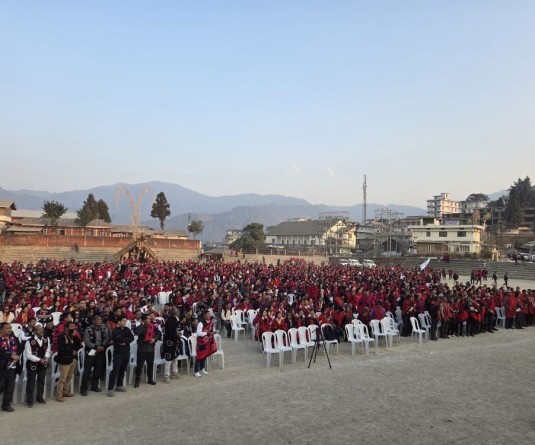
Participants at the child safety conclave in Dimapur on April 7.
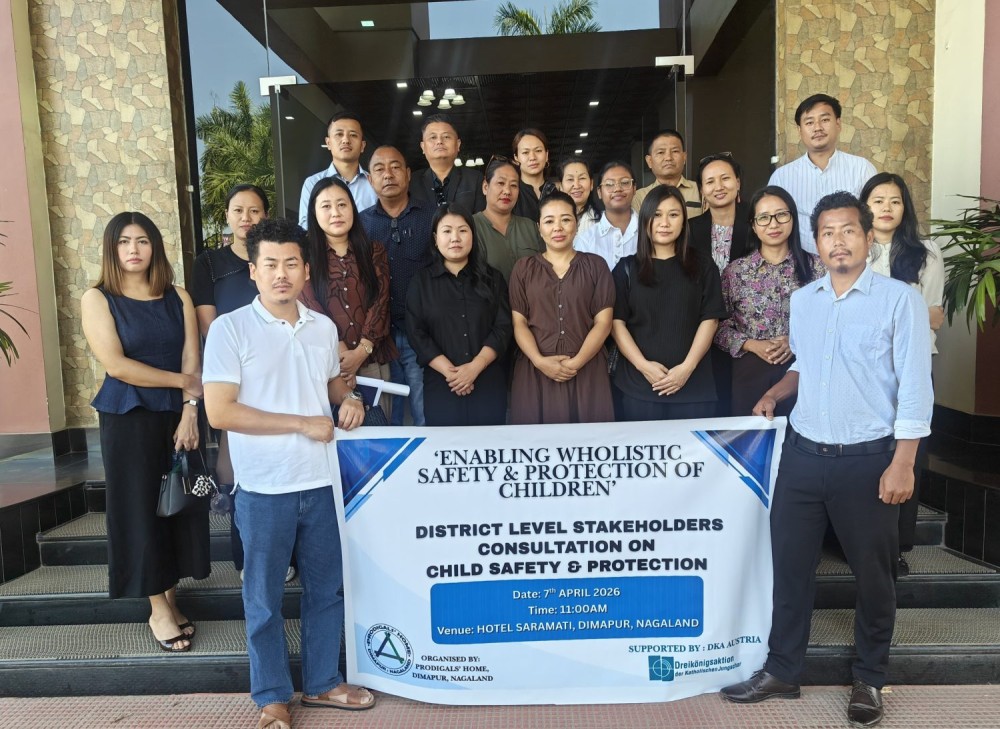
Morung Express News
Dimapur | April 7
Government departments, law enforcement, and civil society representatives convened in Dimapur, on April 7, for a district-level consultation to coordinate an integrated child safety framework for Dimapur, Chümoukedima, and Niuland. K Ela, Director of Prodigals’ Home, Dimapur, presented the progress of the multi-year initiative, focusing on how agencies working directly with children can function as a team to create school-based awareness.
Reporting on Phase I (August 2024–September 2025), titled “Facilitating development and effective implementation of Child Protection Policies,” the Director noted that the project documented best practices in over 30 schools. Achievements included advocacy visits with Mission Vatsalya, the Nagaland Baptist Church Council (NBCC), and the Nagaland State Commission for Protection of Child Rights (NSCPCR). Initial safety mechanisms were also drafted for the transport, hospital, and hospitality sectors.
The consultation served as the launch for Phase II (October 2025–September 2028), “Enabling holistic safety and protection of children in Nagaland” supported by DKA Austria. Planned activities include school awareness campaigns conducted in collaboration with the police, media fellowships, and the creation of digital platforms. A key component of this phase involves translating the main provisions of child protection laws into local tribal dialects for mass sensitization via All India Radio and Mission Vatsalya.
Representing the state’s administrative and legal machinery were the District Child Protection Units (DCPU) of Dimapur and Chümoukedima, and the District Legal Services Authority (DLSA). Nagaland Police representatives included officials from Niuland Police Station, Sovima Police Station and Government Railway Police Station (GRPS), Dimapur.
Educational and frontline perspectives were provided by the Department of School Education (DEO Dimapur), the Child Welfare Committees (CWC) of Dimapur and Chümoukedima, and various units of the Child Helpline (CHL), including Railway Child Helpline responders.
A primary objective of the meeting was to address the trend of under-reporting child abuse in educational institutions. Stakeholders observed that many schools hesitate to report incidents of cyber-bullying or sexual abuse due to concerns over public reputation. The session emphasized that a unified departmental team must work to ensure schools prioritize legal compliance under the POCSO and Juvenile Justice (JJ) Acts over institutional image.
The brainstorming session also covered the complexities of teaching child rights. Some attendees raised concerns regarding the potential for students to misuse rights-based information to blackmail teachers. According to one of the participants, this remains a complex issue to mitigate. Other priorities discussed included mental health and the distinction between safe and unsafe touch.
The consultation called for a multi-agency collaboration to bridge gaps identified in the available protection framework.