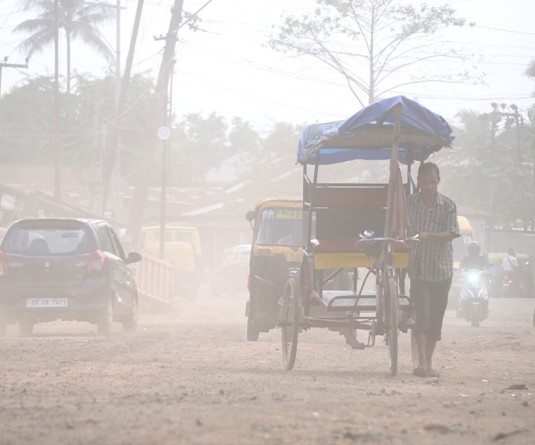
The water source at Sukhalu village, Zunheboto where water is stored and sold. (Morung Photo)
.jpg)
Tokavi K Zhimo
Zunheboto | April 7
A single privately managed water source in Sukhalu village, Zunheboto district continues to serve as a critical lifeline for the town area and several neighbouring villages, even as water levels show a worrying decline over the years.
Owned and managed by local entrepreneur Khetoho Yeptho of Sukhalu village, the water storage facility was built in the early 2000s at an estimated cost of around Rs 5 lakh. It has a storage capacity of approximately 20,000 litres, Yeptho told The Morung Express.
Water is sold at Rs 100 per 2,000 litres, a rate unchanged since the facility was established, he said. The source is used by the public and has previously been utilised by various government departments, including fire and emergency services, police and other central forces, Yeptho informed.
During the peak water scarcity season, he stated that upto 10 trips of water, transported via Bolero pickup vehicles, are sold daily. “People often have to wait in long queues to fetch water,” he said.
The source supplies water to Zunheboto town as well as nearby villages, Yeptho stated observing “a decline in water availability over the years.”
“We are witnessing a significant reduction in water levels every year. The forest area where the water originates remains largely untouched, and it is unclear what is causing this decline,” he said.
He added that the area is naturally rich in water resources and that multiple water sources were found during recent excavation work carried out for construction purposes.
Town council rates, resident struggles
Official of the Zunheboto Town Council (ZTC) said, “water rates in the town are fixed at Rs 1000 per 2000 litres for stream water and Rs 800 per 2000 litres for borewell water.” However, a resident relying on purchased water said, “During peak scarcity, borewell water is sometimes sold at around Rs 900 per 2000 litres.”
“Supplying water is his primary source of livelihood,” a local water distributor said. Meanwhile, tanker drivers and suppliers pointed to rising operational costs including fuel, vehicle maintenance and labour. “The number of trips made in a day depends on demand and availability,” a supplier noted. During peak seasons, multiple trips are made daily, increasing both workload and expenses, he informed.
Some drivers also stated that they occasionally offer marginal discounts to customers in order to sell water more quickly, especially when multiple suppliers operate in the same area.
Changing patterns, rising demand
Suppliers and residents observed changes in water supply patterns over the years, with previously reliable sources showing reduced output. Irregular rainfall, increasing population and rising demand were cited as possible reasons. They further noted that seasonal variations have become more pronounced, with longer dry periods affecting supply consistency.
It was observed by borewell owners “Many surrounding households are connected to borewells through pipelines, paying either a fixed monthly fee or usage-based charges.” They stated that users pay either a fixed monthly fee or charges based on usage.
Some individuals also purchase water for daily needs using containers such as buckets or small storage units, and are charged according to the per-litre rate, either as fixed by the ZTC or slightly below it. Borewell owners added that a growing number of residents are now relying on such sources.
However, some residents, despite having access to borewells near their households, stated that they prefer stream or natural water, citing its freshness, perceived purity and smell, according to one resident and supplier.