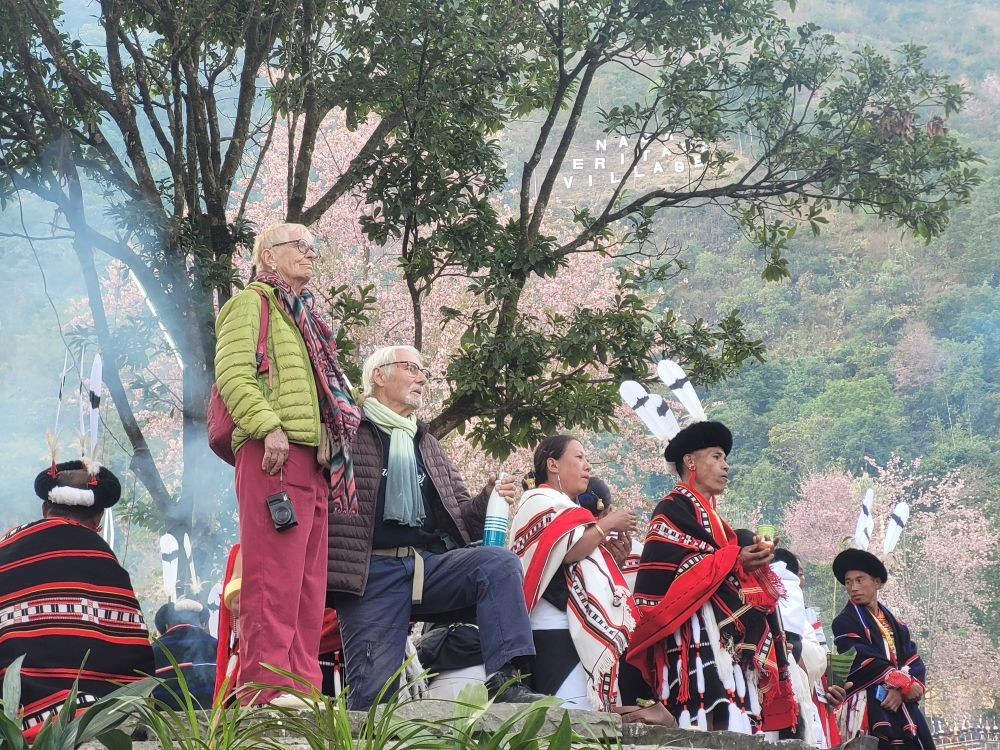
Tourists along with performers taking in the view at the ongoing Hornbill Festival 2025 underway at the Naga Heritage Village, Kisama. (Morung Photo)
Tokavi K Zhimo
Kohima | December 4
As Nagaland celebrates the 26th edition of the Hornbill Festival, often hailed as the “Festival of Festivals,” the event continues to inspire pride while also drawing concerns about whether it is straying from its cultural roots. Many visitors and participants acknowledge the festival as a powerful symbol of unity and global recognition, yet questions persist about commercialization, authenticity, and the presence of alcohol at the venue.
‘Ban alcohol, revive true Naga culture’
One of the strongest concerns came from Khaoshai of the Khiamniungan Union, Kohima. He emphasized that the festival should remain strictly cultural, without veering into practices that dilute traditional values. “Hornbill Festival is a cultural festival, so we should not go the other way,” he said, referring to the increasing visibility of alcohol at the venue.
In his community, Khiamniungan Morung, alcohol is strictly prohibited. “We are doing our cultural practices. That is why we are here—to enrich them. People say there is a lot of local rice beer and wine in Hornbill, and even the government has authorized the sale of alcohol for 10 days. I don’t like that. We say Nagaland for Christ, but only in words, not in action.”
For him, the future of the festival should focus on strengthening and reviving indigenous customs rather than promoting drinking culture or modern fashions. “We should not lose our culture. If it goes on like this, our forefathers’ traditions will disappear. We must develop our real indigenous culture.”
Sharing a similar sentiment, C M Enyu Phom from the Phom Morung expressed the view that the festival in its current form only partially reflects Naga identity. “To be very honest, I think we are not exactly depicting the true Naga culture,” he said.
“For tourists, it may seem exciting, and they may think it is our real culture, but as a Naga, I feel we are not truly showcasing it. It is more focused on food items and drinks, especially indigenous rice beer.”
He acknowledged the vast organizational effort behind the event, but suggested that authorities should introduce clearer regulations so that all tribes participate under a common cultural framework, maintaining authenticity rather than catering primarily to tourist expectations.
Bikram Kachari also felt that alcohol should be banned in future editions, advocating instead for the promotion of traditional Naga drinks without compromising cultural values.
Call to grow, not change
In contrast, others view the Hornbill Festival as an invaluable platform for cultural promotion and economic empowerment. A Sangtam woman who preferred to remain unnamed said, “It is promoting our Naga culture and tradition because we can see so many tourists coming,” she said. “It gives opportunities to local people, not only culturally but also financially. Many tourist and visitors cannot travel to distant places, but through this festival, dance troupes and artisans from remote areas are able to showcase our rich heritage to the world by coming to the same place.” She acknowledged that every festival has some negative aspects, but urged people to focus on the positive impact and improve the event further.
Her primary appeal for the coming years was not cultural but infrastructural: “What we really need is good road connectivity across Nagaland. Road should not be maintained and repaired only in Kisama but should be beyond the main route, the roads are terrible. Tourists arriving via Dimapur also face poor roads. Roads must be improved—not just in the main towns, but everywhere.”
Cliff Sangma, Joint Secretary of Garo Tribal Council, described the Hornbill Festival as a unifying platform. “For all tribes to come together in one moment, this is the only place,” he remarked. He praised the government and stakeholders for globalizing the event and attracting visitors from around the world. “We should take pride in it. You’ll find all the morungs of the recognized tribes here.
Once you enter the venue, you can see the diversity and everything organized in such a way that our culture reaches far beyond India.”
Members of other communities shared similarly optimistic views. Klimtsu Tikhir expressed confidence that the festival is a true representation of Naga culture and affirmed the community’s continued participation in coming years. Pulpen Anpong from the Chang community stressed that preserving culture and tradition should remain central and promised even more engaging performances in future editions.
Thosiepa Katriry, President of Pochury Hoho, Kohima, reflected on the festival’s progress from its 25th to the 26th edition. “The main objective is to promote our culture,” he explained. Representing one of Nagaland’s youngest recognized tribes, he added that the Pochury community looks forward to growing and sharing its unique traditions. He highlighted Achi, a pure, year-aged fermented sticky rice wine exclusive to the Pochury Morung, which has become highly sought after by visitors.
For some, the festival already strikes the right balance. One Nagaland Content creator visitor at Kisama, described it as “a perfect opportunity to showcase our culture.” She believes the festival unites Nagas from different regions and provides a single, vibrant window into the state. “Changes? I wouldn’t want much to change,” she said. “I just hope it gets bigger, and if possible, brings the whole of Nagaland to Kisama.”