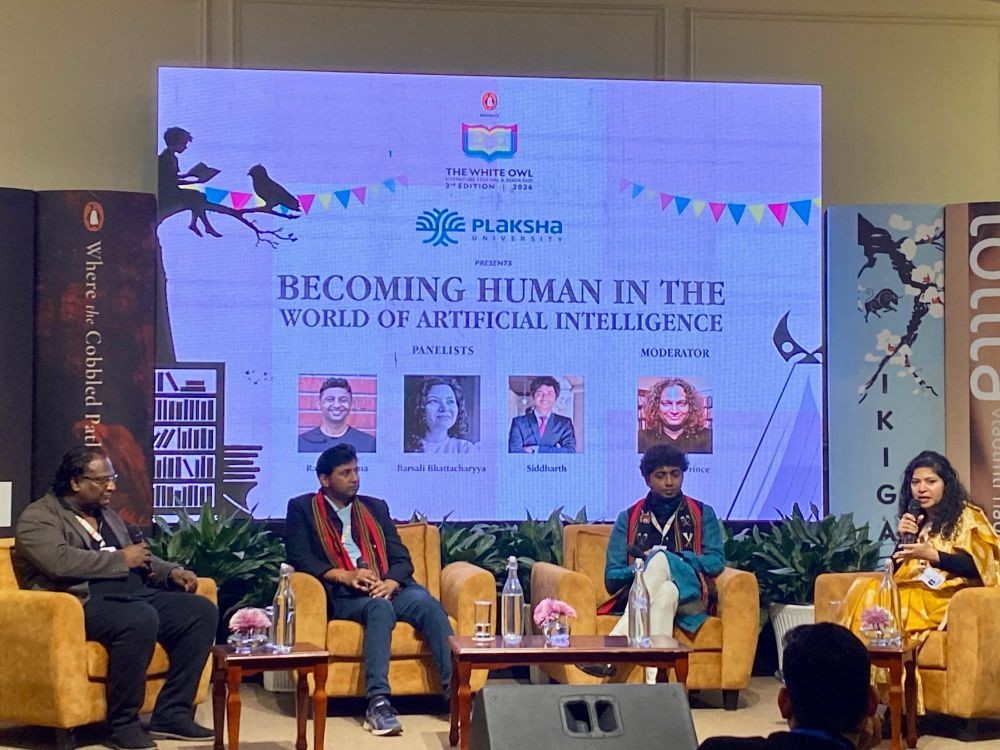
From left: Dr Brainerd Prince, Dr Rajesh Sharma, Dr Siddharth, and Barsali Bhattacharyya during the panel discussion at The White Owl Literature Festival at Zone Niathu, Chümoukedima on February 7. (Morung Photo)
Panel at White Owl examines what it means to be human in AI-driven world
Morung Express News
Chümoukedima | February 7
Artificial Intelligence (AI) may be advancing at breakneck speed, but the question of what it means to remain human in its wake took centre stage on the final day of the White Owl Literature Festival & Book Fair at Zone Niathu, Chümoukedima, on February 7.
A diverse panel on “Becoming Human in the World of Artificial Intelligence (AI)” comprising of Dr Rajesh Sharma, Barsali Bhattacharyya, and Dr Siddharth, with Dr Brainerd Prince as moderator brought together an academic, a researcher, an educator and a journalist to examine how AI is reshaping public life, work and human experience.
Setting the tone for the session, Dr Prince noted that Al is not as innocent as companies often portray it, highlighting both its benefits and challenges. He raised the broader question of how humans can continue to flourish in an Al-driven world.
The pressing concern across the panel was bias, not as a technical glitch but as a societal mirror embedded in code.
Sharma explained that AI systems inherit patterns from their training data.
“You give it the data and you train it; every time you see this, you are supposed to do that,” he said, outlining how repeated associations shape machine outputs.
The problem, he noted, is that historical and cultural prejudices are deeply embedded into digital archives.
“If literature and news associate doctors with men and nurses with women, AI reflects that,” he held, not inventing bias, but scaling it.
Bhattacharyya observed that story prompts frequently defaulted to patriarchal or culturally narrow narratives.
“Technology is going to exacerbate existing bias in our society,” she cautioned.
The concern extended beyond representation. If students, artists, filmmakers, and writers increasingly rely on AI tools trained on skewed datasets, those distortions risk recycling into culture itself, reinforcing stereotypes rather than challenging them.
The panel underscored the intellectual stakes. If knowledge production begins leaning on systems that replicate dominant narratives, marginal voices could be flattened further. Bias, in this sense, is not only algorithmic but civilisational, shaping whose stories are told and whose are erased.
Setting context, Bhattarcharyya described AI as a foundational, general-purpose technology like electricity or the internet.
She noted that many tools once branded AI, such as facial recognition have already faded into everyday infrastructure, from phone unlocking to airport verification.
Siddharth traced AI’s philosophical roots to Alan Turing’s post-war Turing Test. “It took about seven decades, and when ChatGPT came out in 2022, it was able to ace that threshold of human-like interaction,” he said. “For the first time, language, long considered human property, is being simulated at scale.”
He illustrated AI’s evolution through robotics. Earlier machines required step-by-step programming to perform simple navigation tasks. Today, systems learn by observing humans.
Dual impact on employment
On jobs, Siddharth acknowledged AI’s dual impact. “AI is helping engineers, students, creators, everyone. But the pivot has to be, how do we co-exist with AI as co-creators rather than competitors?”
Bhattarcharyya agreed new roles would emerge but questioned their quality. Data-labelling work, training AI systems often involves repetitive, low-paid labour concentrated in the global South.
Referencing the film ‘Human in the Loop,’ she asked, “Sure, the role has changed, but is anyone better off?”
She also pointed to subtle workplace shifts. AI meeting assistants are automating note-taking, tasks historically and disproportionately assigned to women. “That’s one skill that is no longer there, and hopefully it frees us up to do something else,” she said.
Creativity & education
In education, Siddharth cited studies suggesting AI enhances individual creativity by enabling rapid ideation.
However, collective originality may decline. As a community, creativity starts to decrease when everyone uses the same tools trained on the same data, he stated.
Prince advocated that students may use AI for research support, but original thinking must remain central. “The first draft has to come from within you,” he said, cautioning against overreliance and hallucinated outputs.
Universities, he noted, remain divided between prohibition and compulsory AI literacy.
The discussion also touched on emotional AI chatbots and virtual partners designed to alleviate loneliness. “These are synthetic relationships,” Bhattarcharyya said. “They can never mirror a human relationship.”
Human touch- the irreplaceable differentiator
Asked what remains uniquely human, Siddharth pointed to physical social spaces such as football grounds where people learn teamwork and resolve conflicts face to face. He lamented that children today often sit together but remain absorbed in their screens.
Rajesh emphasised empathy, “that human touch,” as an irreplaceable differentiator. Bhattarcharyya pointed to imperfection.
“To err is human,” she said. “Our vulnerabilities, our authenticity, that is what will make us stand apart in a crowd of AI-generated content.”
Across work, education, and relationships, the conversation repeatedly returned to bias as the defining fault line. AI may replicate human capability, but it also replicates human prejudice.
In the race to build intelligent machines, the panel suggested, the greater test may be whether society can build fairer datasets and fairer worlds for the machines to learn from. The closing session was hosted by poet-novelist Easterine Kire and Vizovono Elizabeth.