DC Kohima B Henok Buchem and other during the release of aquifer mapping during the district-level workshop held in Kohima on February 16. (DIPR Photo)
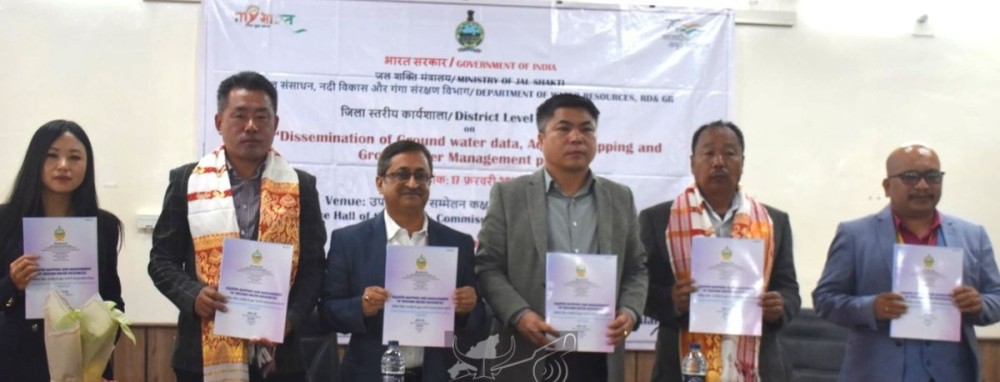
Kohima, February 17 (MExN): A district-level workshop on the ‘Dissemination of Ground Water Data, Aquifer Mapping and Groundwater Management Plans of CGWB” was organised here by the Central Ground Water Board (CGWB)’ in Kohima on February 16.
The workshop, held at the conference hall of the Deputy Commissioner, Kohima aimed to create awareness among government officials, scientists, and academicians about sustainable groundwater governance, a DIPR report said. It focused on promoting effective utilisation of groundwater data for sustainable governance and management.
The programme was conducted by the CGWB, North Eastern Region, Guwahati, the Ministry of Jal Shakti, Government of India.
DC seeks action plan to combat water woes
Addressing as the special guest, the Deputy Commissioner, Kohima, B Henok Buchem stated that the CGWB is the national apex agency mandated to provide scientific inputs for management, exploration, monitoring, assessment, augmentation and regulation of groundwater resources in the country.
He said the workshop aims to disseminate findings of the National Aquifer Mapping (NAQUIM) studies, create awareness on groundwater management and quality issues, highlight successful case studies and share information on schemes under the Ministry of Jal Shakti applicable to the district.
Stressing that groundwater management is a key indicator of sustainable development, the DC emphasised the need to “translate scientific data into informed policies and tangible programmes” in the context of the Viksit Bharat 2047 vision and the Sustainable Development Goals (SDG) 2030.
Speaking at the workshop, the DC highlighted the dual challenge faced by the district, which experiences water surplus during the monsoon and acute scarcity in the lean season. He urged various departmental officials to submit recommendations so that a comprehensive proposal can be forwarded to the State Government.
CGWB shifts focus to hill areas under NAQUIM 2.0
Regional Director, CGWB, North Eastern Region, Tapan Chakraborty, said the Board has been working in the North East for many years and has undertaken groundwater exploration activities in the region, particularly in Dimapur district.
He stated that earlier greater emphasis was given to groundwater in the plains, but under the National Aquifer Mapping Programme (NAQUIM), now in its 2.0 phase, hill areas are also being given due importance.
He highlighted that in hill states, people largely depend on springs and streams, and studies have been conducted in Kohima to assess spring shed management and water scarcity issues. He stressed the importance of water level and water quality monitoring and urged stakeholders to integrate CGWB data for effective planning. He encouraged interactive discussions and suggestions from participants.
Chief Engineer, Water Resources Department, Nagaland, Er Thepfusalie Guozi, attending as guest of honour, expressed appreciation to CGWB for organising the workshop.
He observed that Nagaland is blessed with abundant freshwater resources from streams, which are rich in essential minerals. However, he noted that many natural water sources are now drying up or getting polluted. He emphasised the need to restore and manage natural resources sustainably for future generations. Stating that groundwater accounts for nearly 30% of freshwater resources, he said it must be utilised optimally as it is not an infinite resource.
During the technical session, Anenuo Pienyu, Scientist-C, CGWB, State Unit Office, Shillong, presented the findings of aquifer mapping and spring shed management studies in Kohima district. The activities and mandates of CGWB were also highlighted by Dr SS Singh, Scientist- D, CGWB, NER, Guwahati.
The workshop included demonstration of data access through web portals and GIS tools such as cgwbdata.gov.in, IN-GRESS and IndiaWRIS, followed by discussion, feedback and question-answer sessions to understand local-level data requirements.
It was informed that CGWB, under the Ministry of Jal Shakti functions as the national apex agency with 18 Regional Offices across the country, supported by Engineering Divisions and State Unit Offices. In the North East, the Regional Office is located at Guwahati, Assam.