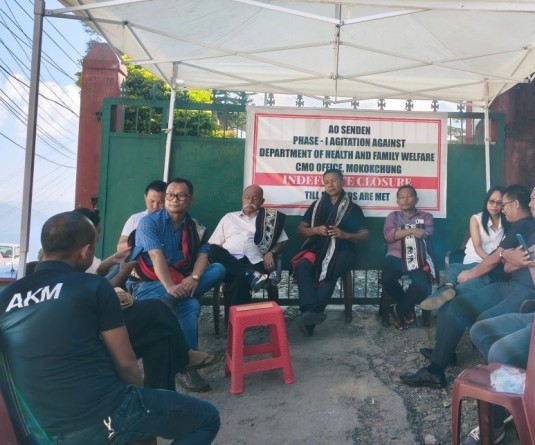
DC Zunheboto Dharam Raj, IAS Chairing the DLC Meeting on July 16. (Morung Photo)
.JPG)
Morung Express News
Zunheboto | July 16
The District Implementation Committee (DIC) for the PM Vishwakarma Scheme held a review and planning meeting at the Office Chamber of Deputy Commissioner, Zunheboto, on July 16 to assess the progress of the flagship scheme and deliberate on measures to address implementation challenges in the district.
Chairing the meeting, Deputy Commissioner Dharam Raj, IAS, stressed that skilling and credit linkages remain the two key focus areas requiring sustained attention to ensure the successful implementation of the scheme. ‘While significant progress has been made, greater coordination among departments, financial institutions and training agencies is necessary to improve outcomes for artisans,’ he observed.
The DC also stressed that a monthly review meetings be conducted to closely monitor the implementation process, evaluate progress, and identify challenges at every stage. ‘Regular reviews would enable stakeholders to resolve bottlenecks promptly and ensure that eligible artisans receive the intended benefits under the scheme,’ he added.
Presenting the district status report, Er N Toky Chishi, General Manager, District Industries Centre (DIC), Zunheboto, informed the committee that 183 artisans comprising 124 basket makers and 59 carpenters have successfully completed training and assessment under the PM Vishwakarma Scheme. Training has been conducted through the Industrial Training Institute (ITI), Zunheboto, while Khelhoshe Polytechnic, Atoizu, though empanelled as a training centre, is yet to commence training as the distance inconvenience.
The report stated that 98 basket makers have received their toolkits, which are dispatched directly by the Ministry of Micro, Small and Medium Enterprises (MoMSME) to artisans' Aadhaar-linked addresses. Since the distribution is handled directly by the Ministry, the State Government has no direct control over deliveries. Delays in toolkit distribution have already been taken up with the Ministry, which is prioritising deliveries ahead of the scheme's third anniversary on September 17, 2026.
However, despite the delivery of 98 toolkits, none were recorded through the PM Vishwakarma mobile application, resulting in the central portal reflecting zero toolkit deliveries for Zunheboto. The report recommended that postal authorities use the designated mobile application during deliveries to ensure proper documentation.
Under the credit component, 24 artisans have availed loans under the scheme, of which four accounts have turned into Non-Performing Assets (NPAs). The District Industries Centre has been regularly contacting beneficiaries to remind them of timely repayment of their EMIs.
The report further revealed that 131 loan applications were rejected by banks, including 108 cases marked as “Artisan denied loan.” During verification, several applicants reportedly stated that they had never received any calls from the banks, raising concerns over the verification process. It was also highlighted that guarantors were reportedly demanded in certain cases at the SBI Zunheboto Branch despite such a requirement being contrary to the scheme guidelines.
To improve access to credit, the DIC identified eight artisans actively engaged in production who are willing to avail loans and recommended forwarding their names, along with verification reports, to the Lead District Manager, SBI, for further consideration.
The report also noted that 118 Stage-III verified basket weavers and 25 carpenters are yet to undergo training. While most of the artisans are based in Zunheboto town, many carpenters reportedly declined to participate in the training programme. It was further informed that ITI Zunheboto will exhaust its training funds after the current batch of 20 basket weavers, and future training programmes will depend on the release of capital expenditure funds from the Ministry.
Concerns were also raised regarding the proposed residential training at Atoizu, with artisans citing the distance as a challenge. Under the scheme, trainees receive a Direct Benefit Transfer (DBT) stipend of Rs. 6,250, covering lodging, travel and daily allowances. The report recommended greater mobilisation efforts by the District Industries Centre, training institutions and the District Project Management Unit (DPMU) to encourage participation.
Marketing challenges were another major issue discussed during the meeting. The report observed that the local market is largely saturated with plastic baskets, while demand for traditional bamboo baskets remains limited outside the district. It suggested diversifying production by introducing banana fibre and jute basket weaving to align with evolving market demand. It also proposed identifying artisans who have already received training, toolkits and credit for onboarding onto e-commerce platforms through GST registration, subject to their willingness.