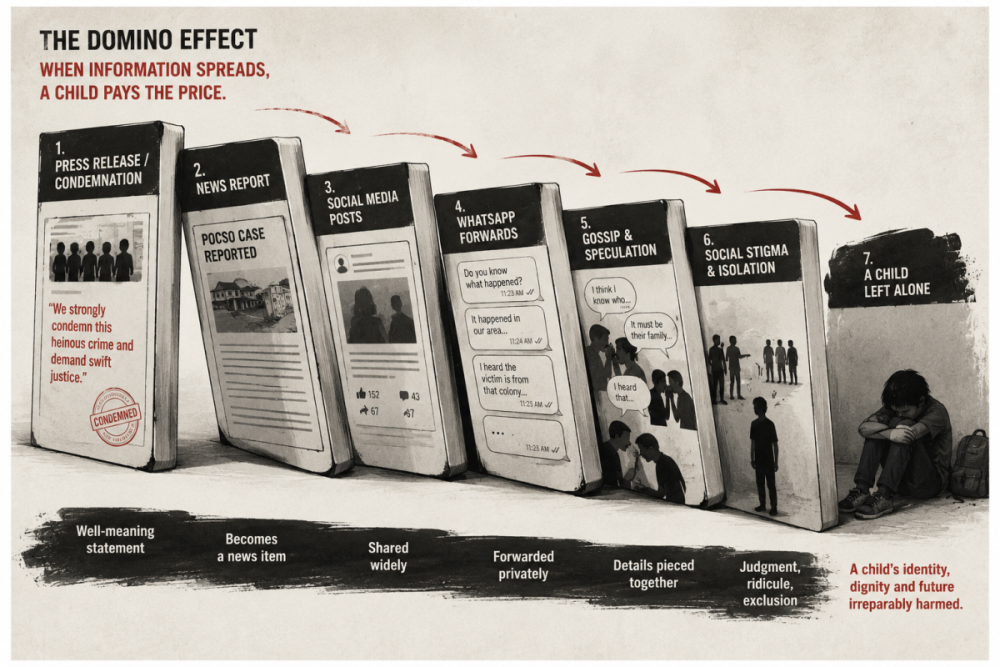
As information passes from official statements to news reports, social media and word of mouth, anonymity can give way to identification, leaving lasting consequences for child victims.
Of crime, condemnation, demands and no stones left unturned
Imkong Walling
Dimapur | June 29
Outrage and demand for swift justice is generally the societal reaction to crime against children. Civil society-led “condemnation”, including those routed through the media, censuring rape and murder is an accepted convention. But ignorance of the law and lack of sensitivity comes to fore when the statements contain information revealing the details of the victim. In close-knit societies, like in Nagaland, such well-meaning gestures can sometimes run counter to the legal safeguards designed to protect child victims, especially, of sexual crimes from needless publicity, according to legal experts and juvenile rights advocacy.
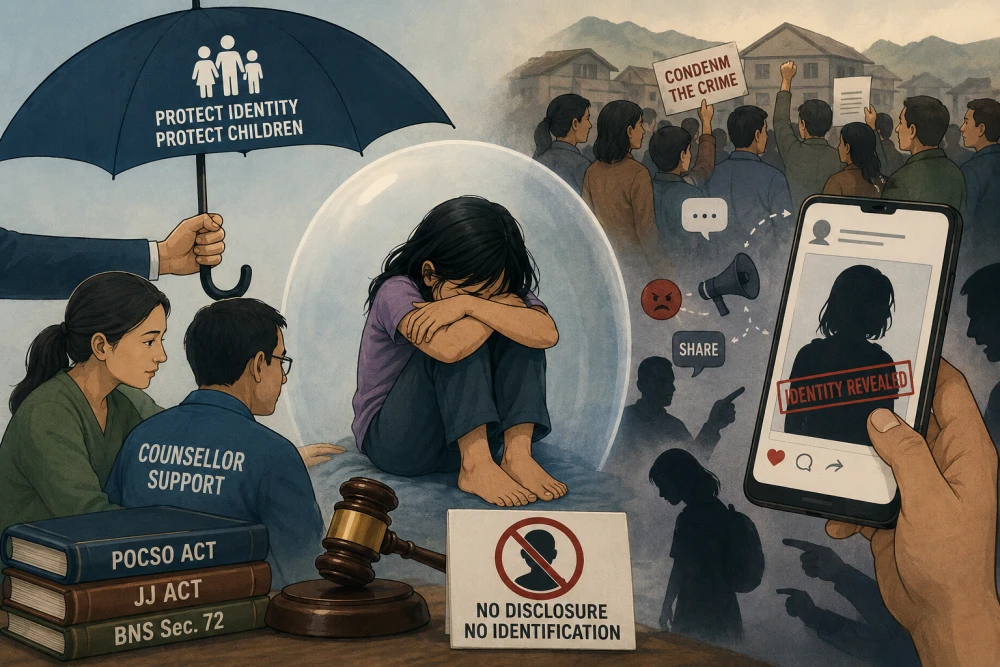
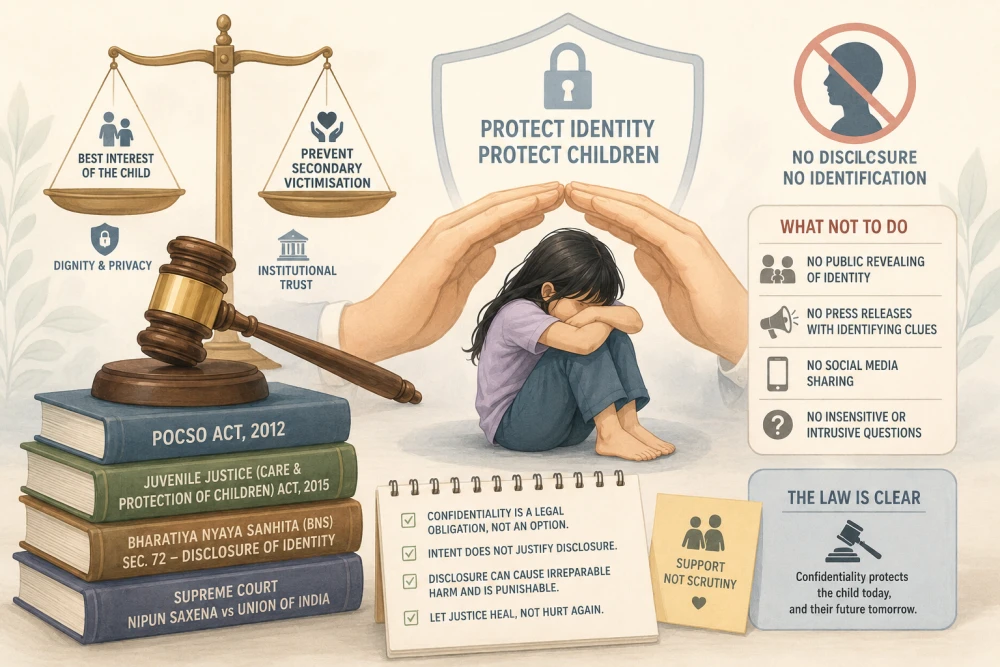
Indian law governing children's safety and rights deems identity protection for child victims of crime essential to ensuring justice and rehabilitation. Laws like the Protection of Children from Sexual Offences (POCSO) Act, Juvenile Justice (Care and Protection of Children) Act, and other special laws, were enacted to serve this purpose. The legal provisions were reinforced by the Supreme Court in the landmark Nipun Saxena versus Union of India case. Section 72 of the Bharatiya Nyaya Sanhita (BNS) treats “Disclosure of identity of victim of certain offences” as a punishable offence.
Anonymity obligation
But what is the rationale behind the anonymity obligation? It is a deliberate attempt at preventing what legal experts describe as “social death” in cases involving offences of a sexual nature. It implies the stigma attached to a child victim’s public identity. The confidentiality edict is based on four principles— doctrine of the best interest of the child, prevention of secondary victimisation, constitutional right to live with dignity, and the safeguarding of institutional trust to prevent under-reporting.
“In many communities, the social stigma attached to sexual offenses can be as damaging as the crime itself. When a child's identity is exposed, they face immediate isolation, pity, or judgment from peers, neighbors, and schools… becomes a permanent barrier to their future rehabilitation, long after the legal trial is over. The law mandates confidentiality to prevent this social death,” said Winona, an advocate.
In Nagaland, however, there is a perceived disregard for drawing a line between what should remain confidential and what not. The rise of the internet and the prevailing customs has apparently amplified the insensitivity.
There was a consensus among the commentators quoted in this report that social media together with community-led expression of solidarity and condemnation, in particular, have created a challenging environment for maintaining confidentiality in cases involving children.
She held that while the traditional media has largely matured, digital and citizen journalism remain vulnerable. “Once a crime occurs in a small community, word spreads rapidly through tight-knit social networks, rendering the legal anonymity shield practically ineffective on the ground,” said Winona, who has spent years handling cases related to vulnerable demographic.
Conventional trials balance the rights of the accused against the public’s right to open justice. “However, when a minor is involved, the child's welfare is paramount,” she said, while adding that the law explicitly acknowledges that a child’s right to privacy and psychological well-being outweighs public curiosity or the media’s right to information.
She asserted that confidentiality is a non-negotiable statutory mandate, not a procedural courtesy, when dealing with sexual offenses against children.
As per the law, it remains a statutory violation even if a community body or citizen leaks details with “supportive intent.” It basically means that good intention does not justify disclosure of the victim’s personal details. “A critical nuance emphasised by the Supreme Court of India is that intent does not dilute criminal liability when it comes to disclosure,” she said.
Price of prying
While the statutory framework is robust on paper, its implementation on the ground faces severe challenges, again, in tight-knit communities where information spreads rapidly.
Jennifer, an NGO worker, formerly involved in child rights activism observed what was described as “collective/tribal dynamics” prevailing over the privacy of the child. She said that it frequently manifests through “paper condemnations,” or press statements issued by tribal bodies, student unions, and neighborhood councils.
A recent POCSO case was cited as an example. This case also followed the familiar pattern of organisations issuing ‘condemnation notes.’ These notes did not publish the victim’s identity. The victim’s identity was, however, decoded through the accused’s personal details; in the process, violating Section 23 of the POCSO Act.
She said, “Confidentiality is compromised by our close-knit social structure. This closeness affects the case because everyone wants to find out and share the story. In such situations, it can pressure and confuse the child.”
Recalling her field experience, she said that unions often demand to meet the child, and end up asking insensitive questions regarding physical contact, which violates Section 24(5) of the POCSO Act and Rule 4 of the POCSO Rules, 2020.
While the concern is understandable, she said that intrusive questions, though well-meaning, causes unwarranted stress, further resulting in victims to withdraw and stop cooperating. According to her, this is why access is legally limited to immediate family, CWC-appointed Support Persons, and authorised officials only.
Jennifer asserted that Nagas are deeply caring by nature. But a child in trauma needs space, professional support, love and healing, not scrutiny and prying questions.
She added, “The rise of social media and insensitive questions from reporters further aggravates the issue. Every media post either print or digital risks further trauma, contravening the ‘best interest of the child’ principle under Section 3 of the Juvenile Justice Act, 2015.” Besides, she said that such publicity could also hinder police investigation, as information reaching the perpetrator can enable escape or destruction of evidence.
Similar sentiment was expressed by the advocate. “Whenever a crime against a child occurs, tribal hohos, student unions, and colony councils immediately flood the local dailies with press releases condemning the act.” According to her, these statements often do more to project the organisation’s moral stance than to protect the child. In the haste to condemn the act, she said that identification markers get included, inadvertently doing more harm than intended.
The knock-on
When the cloak of confidentiality gets drawn, the damage to the child and their family is often permanent and far-reaching. Kate, a child rights activist, recalled instances when public exposure led to extreme distress for families. In some instances, the families faced verbal abuse and public scrutiny after media outlets allegedly disclosed a victim’s place of residence. “Unable to endure it, the victim's family decided to withdraw the complaint,” said Kate of one particular case. According to her, some children refuse to continue their studies due to shame and even develop suicidal tendency.
“As concerned adults, we need to act more responsibly and wisely when it comes to such cases. We can condemn the act without posting the names or details of the victim. Protecting our children and safeguarding their dignity should be a priority,” said Kate.
While maintaining the victim’s privacy remains the top priority, Jennifer, the NGO worker, also called for respecting the perpetrator’s family. “They often suffer stigma in silence. In most cases, the family is unaware of and uninvolved in the crime,” she said.
A police officer, also speaking on condition of anonymity, said that public disclosure of case details complicates matters in ways that, on most occasions, remain indiscernible to the public eye. “The police revealing certain details to the media, which might not necessarily violate the law, could potentially break the trust the family (and victim) placed on the investigator,” the officer said.
Investigation, especially in POCSO cases, involves a great deal of trust-building between investigators and victims. Maintaining discretion provides a sense of security to the victims and their families. “As long as it is confidential, there is a sense of security to fully cooperate from the victim’s side.” When trust erodes, the officer said that it risks withdrawal of cooperation. The officer added that protecting victim confidentiality helps in mitigating the social stigma that often leads to silence.
Gap and delays
While organisations like Childline provide immediate intervention, long-term follow-up is legally the responsibility of the District Child Protection Units (DCPU).
Without sustained support, the combination of social stigma and lack of family backing can lead to tragic outcomes. Jennifer, the NGO worker, recalled the case of a girl, who felt “discarded” after falling victim to sexual abuse as a minor. She left her hometown to work elsewhere and reportedly entered sex work. Jennifer said, “This happened because she felt discarded by her family and believed society would no longer accept her... she felt entirely disposable.”
Judicial delays further compound the trauma. Under the POCSO Act, cases are intended to be resolved within one year, but in practice, they drag on for years. During these long periods, she said that the accused may secure bail, leading to instances where victims are threatened and subsequently turn hostile in court.
There is the state-funded Victim Compensation Scheme, with payouts ranging from Rs 1 lakh to over Rs 10 lakh depending on the severity of the case, alongside immediate interim relief for medical emergencies. Majority of commentators were of the opinion that financial compensation cannot replace the psychological need for a secure, confidential environment.
Improving consciousness?
While the lack of sensitivity come under criticism, there seems to be growing awareness about the significance, and legal requirement for maintaining confidentiality in cases involving child victims, according to a state Child Protection official. The official cited instances when the child victim underwent severe psychological distress, causing depression and suicidal tendencies, following leaking of sensitive case details.
The fugitive preacher Robert Kikon case was cited as one primary example when identity disclosures on the media hampered child protection efforts. “And sometimes, when it is leaked like this, the victim gets traumatised, and compromise protection effort.”
The official, however, held that there is growing public, and media awareness. The shift was attributed to sensitisation campaigns. The official noted the use of disclaimers on social media posts pointing to a perceived growing awareness among social media users regarding protection of victims' identities.
Disclaimer: All the commentators interviewed for the story requested anonymity citing the sensitive nature of their work and concern over societal repercussion. Pseudonyms were used to protect their identities.
This report is part of the ‘Media Fellowship Initiative on Child Protection Awareness and Ethical Public Discourse’ series, supported by DKA Austria and implemented by Prodigals’ Home. The content is intended for public legal literacy and preventive awareness and does not constitute legal advice.