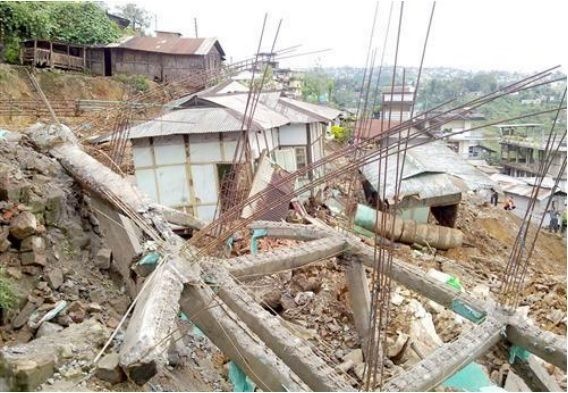
Some of the houses damaged by the landslide at lower Chandmari area, Kohima town.
Our Correspondent
Kohima | April 11
The Nagaland State Disaster Management Authority (NSDMA), under the state Home Department, has released the Nagaland State Disaster Management Plan, which was tabled in the 8th session of the 14th Nagaland Legislative Assembly (NLA) by Chief Minister Dr Neiphiu Rio.
The plan highlights that natural and anthropogenic damage to the environment, exacerbated by adverse geological and climatic conditions, rapid population growth, increased concentration of people in hazardous zones, and lack of adequate infrastructure, has led to a rise in the frequency and severity of disasters in the state.
According to the executive summary of the plan, potential and real hazards identified by the state government include natural disasters such as earthquakes, landslides, floods, fires and droughts, as well as man-made catastrophes including forest fires, chemical accidents, and gas-related incidents.
Recognising the need to address disaster response and management at both micro and macro levels, the state government has adopted a holistic approach. This ensures the involvement of state machinery, district functionaries, NGOs, all relevant stakeholders, and traditional village councils right down to individual village units.
The Plan integrates national and state-level policies and guidelines while making a conscious effort to incorporate indigenous concepts, practices and wisdom that local tribes and communities have traditionally used for decades to ward off or respond to disasters.
The state government has acknowledged the need for a proactive and sustainable approach to disaster management. The plan lays down specific guidelines and provisions to equip entities at the state, district, and village levels to respond effectively at any time during a disaster.
“Disaster management involves a holistic approach to problem-solving relating to any kind of disaster irrespective of its magnitude,” the executive summary stated, adding that the state government realises its responsibility to initiate, adopt, and implement disaster management as an integral part of state policy.
Emphasising a people-first approach, the plan recognises the importance of active participation from communities, particularly in Nagaland where tribal communities have inherent traditional systems of ties and bonding.
The plan also underscores the need to rely on locally available resources, including knowledge, personnel, and material, to ensure a more efficient, cost-effective, and quicker response. The political and administrative machinery will be made responsive, while civic bodies, social organisations, institutions, community-based organisations, tribal hohos, and voluntary organisations will be actively involved. Participation and partnership at all levels of planning, capacity building, response activities, monitoring, and rehabilitation will be encouraged, the summary stated.
The Disaster Management Act will be enacted, and each district will develop its own disaster management plan, it added.
Vision, policy & theme
The vision of the plan is making Nagaland where communities react to disasters with sense of urgency but in a planned way to minimize human, property and environmental loss.
Saving of human lives will be at the highest priority however, plan will also address minimum loss of property and environment, it stated.
In term of theme, it stated that it comprises risk and vulnerability assessment of disasters in the State. It provides planning for prevention and mitigation, mainstreaming disaster in development plans, programmes, projects, capacity building and preparedness measures, the role and responsibilities of each government departments and other stakeholders, risk transfer mechanism and effective programme management for future disasters.
It also provides for reviewing and updating the plan annually.
Objectives
The plan has outlined a comprehensive set of objectives aimed at building a disaster-resilient state, with a focus on protecting lives, minimising suffering, and reducing vulnerability across all levels of society.
At the core of the plan is the objective to protect and minimise loss of lives and property and infrastructure from disasters, while simultaneously reducing the suffering of people affected by such events.
The plan seeks to promote a culture of prevention and mitigation through curriculum revision, Information Education Communication (IEC) awareness campaigns, mock drills, and disaster management plans at all levels. It also aims to communicate hazard, risk, and vulnerability information at the community level while streamlining the institutional techno-legal framework.
Capacity building for all stakeholders in the state is another key objective, with a strong emphasis on community-based disaster management. The plan also calls for mainstreaming disaster management concerns into the developmental planning process.
The plan further aims to develop an efficient disaster response and relief mechanism in the state, while providing clarity on roles and responsibilities for all stakeholders involved in disaster management.
Ensuring coordination and fostering productive partnerships with all agencies related to disaster management has also been identified as a priority objective.
The plan additionally envisions that recovery programmes following any disaster be treated as an opportunity to build better disaster management frameworks for the future, with active community participation at the centre of such efforts.